Short answer: Roopkund is not a beginner’s trek, but it isn’t a mountaineering expedition either. It sits in an in-between zone that trips people up precisely because “moderate to difficult” sounds vague until you break down what it actually means on the ground, day by day. This is that breakdown.
Why we grade it moderate to difficult, not just moderate
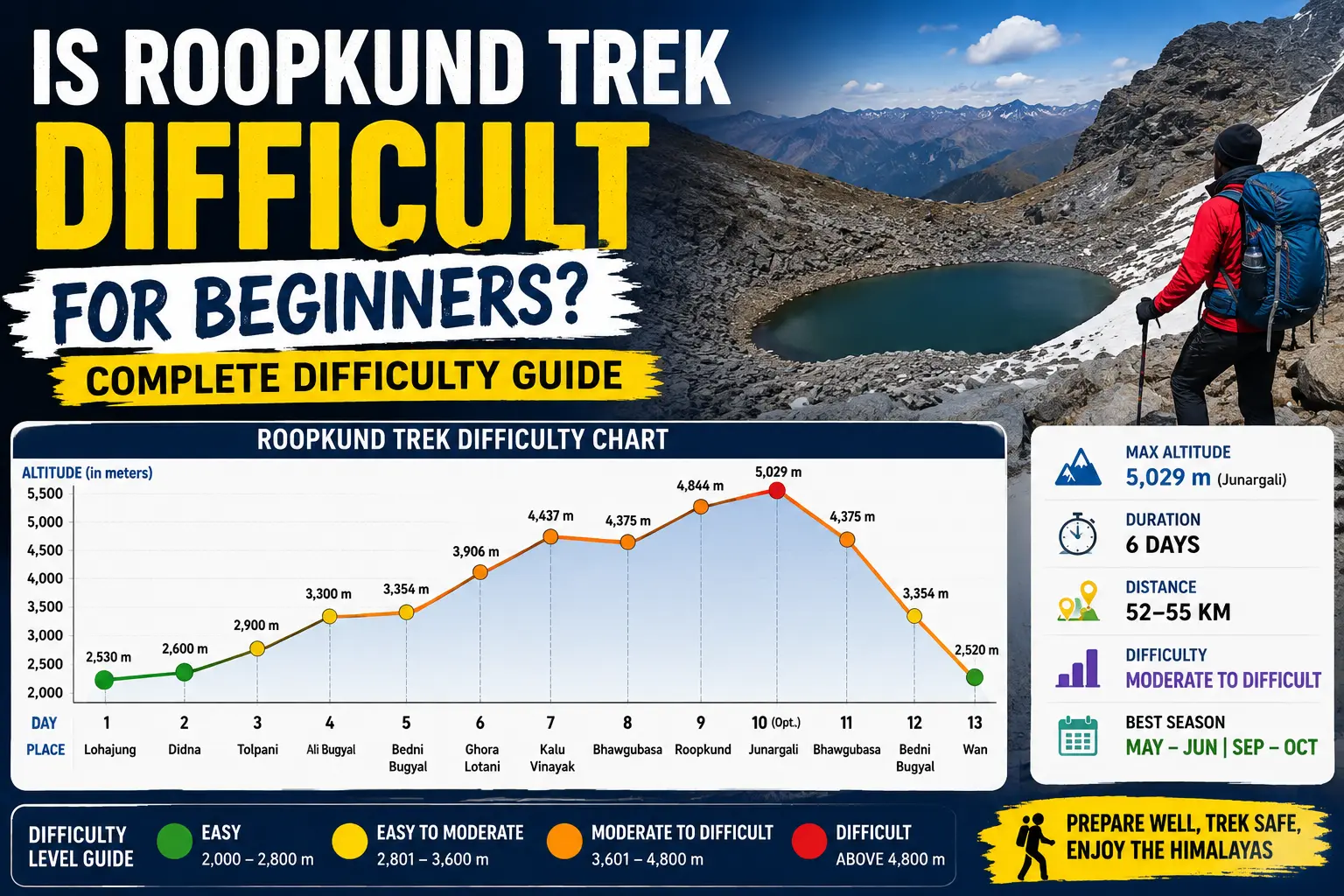
Two things push Roopkund up a notch from a standard moderate trek: altitude gain and daily walking hours. You start at Lohajung around 7,650 feet and reach Roopkund Lake at 16,499 feet in five trekking days — a gain of nearly 9,000 feet, with the steepest part of that climb concentrated in the second half of the trek. Compare that to a genuinely beginner-friendly trek like Kedarkantha, which tops out around 12,500 feet over a similar number of days with a gentler gradient throughout, and the difference in what your body has to handle becomes obvious.
You might be interested in these treks
Roopkund Trek
₹15,500
Hampta Pass Trek
₹7,500
Ranthan Kharak Trek
₹9,500
Kagbhusandi Lake Trek
₹29,500
Bhrigu Lake Trek
₹8,599
On top of the altitude, two of the eight days — Day 6 (summit day to Roopkund and back) and Day 7 (the long descent to Wan) — run 7 to 8 hours of walking each. That’s a longer sustained effort than most first Himalayan treks ask of you, and it comes back-to-back, with limited recovery time in between.
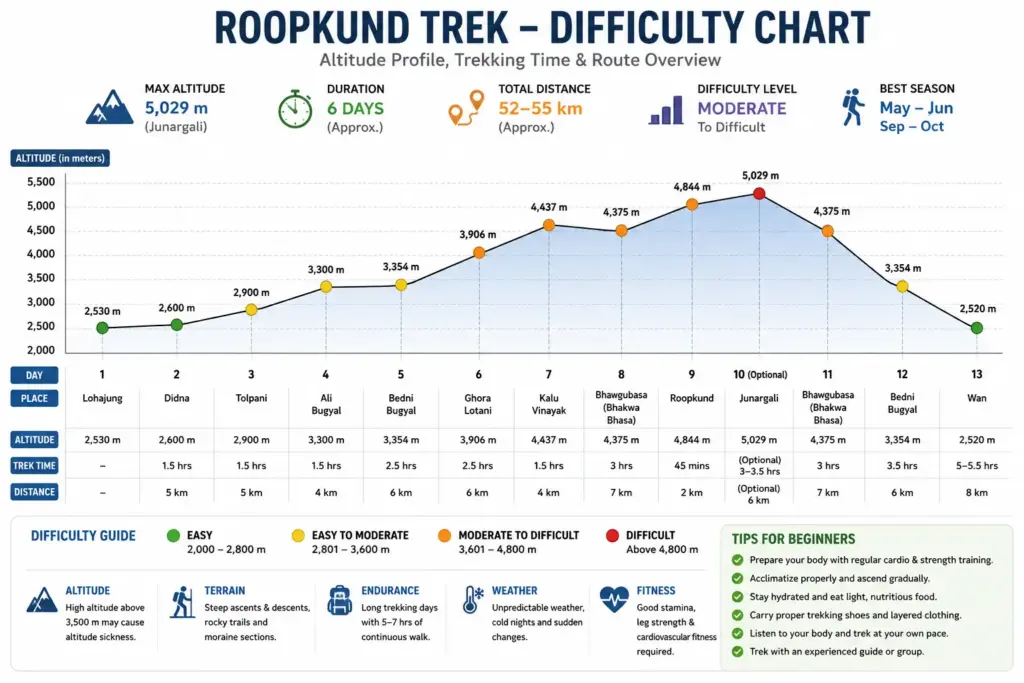
A day-by-day difficulty breakdown
- Day 1 — Rishikesh to Lohajung: Just a drive. Zero difficulty, but the altitude at Lohajung (7,650 ft) is already enough for some people to feel mild effects if they’ve flown in from sea level with no buffer day.
- Day 2 — Lohajung to Didna: A 9 km climb through forest, moderate effort, nothing technical. A reasonable introduction to what the trek demands.
- Day 3 — Didna to Aali Bugyal: The single toughest day by distance and elevation gain — 12 km with a climb from 8,150 ft to 12,200 ft. This is where unfit trekkers usually feel it first.
- Day 4 — Aali Bugyal to Patar Nachauni: Shorter and gentler, largely by design — this is an acclimatization day built into the schedule on purpose.
- Day 5 — Patar Nachauni to Bhagwabasa: Short distance, but a genuinely steep climb to the Kalu Vinayak shrine at altitude, where thinner air starts to matter more than fitness.
- Day 6 — Bhagwabasa to Roopkund and back: The hardest day on the trek — a pre-dawn start, loose rock and snowfields, up to 16,499 ft and back, 7–8 hours total.
- Day 7 — Patar Nachauni to Wan to Lohajung: Not technically hard, but long — 15 km of descent that tests your knees more than your lungs.
- Day 8 — Lohajung to Rishikesh: Just a drive back.
Who should attempt this trek
We recommend Roopkund to trekkers who’ve already completed at least one multi-day Himalayan trek — something in the Kedarkantha, Brahmatal or Har Ki Dun range — or who are committing to serious, structured fitness training in the 6 to 8 weeks before departure. Our own fitness benchmark is straightforward: you should be able to comfortably cover 8 km in under an hour, plus manage a 2 km run, before joining the batch.
Age 15 and above is generally fine if genuinely fit and reasonably experienced with physical activity — we’ve had first-time trekkers complete Roopkund successfully. What matters more than raw age is honest self-assessment of your cardiovascular fitness and your comfort with cold, altitude, and long walking days.
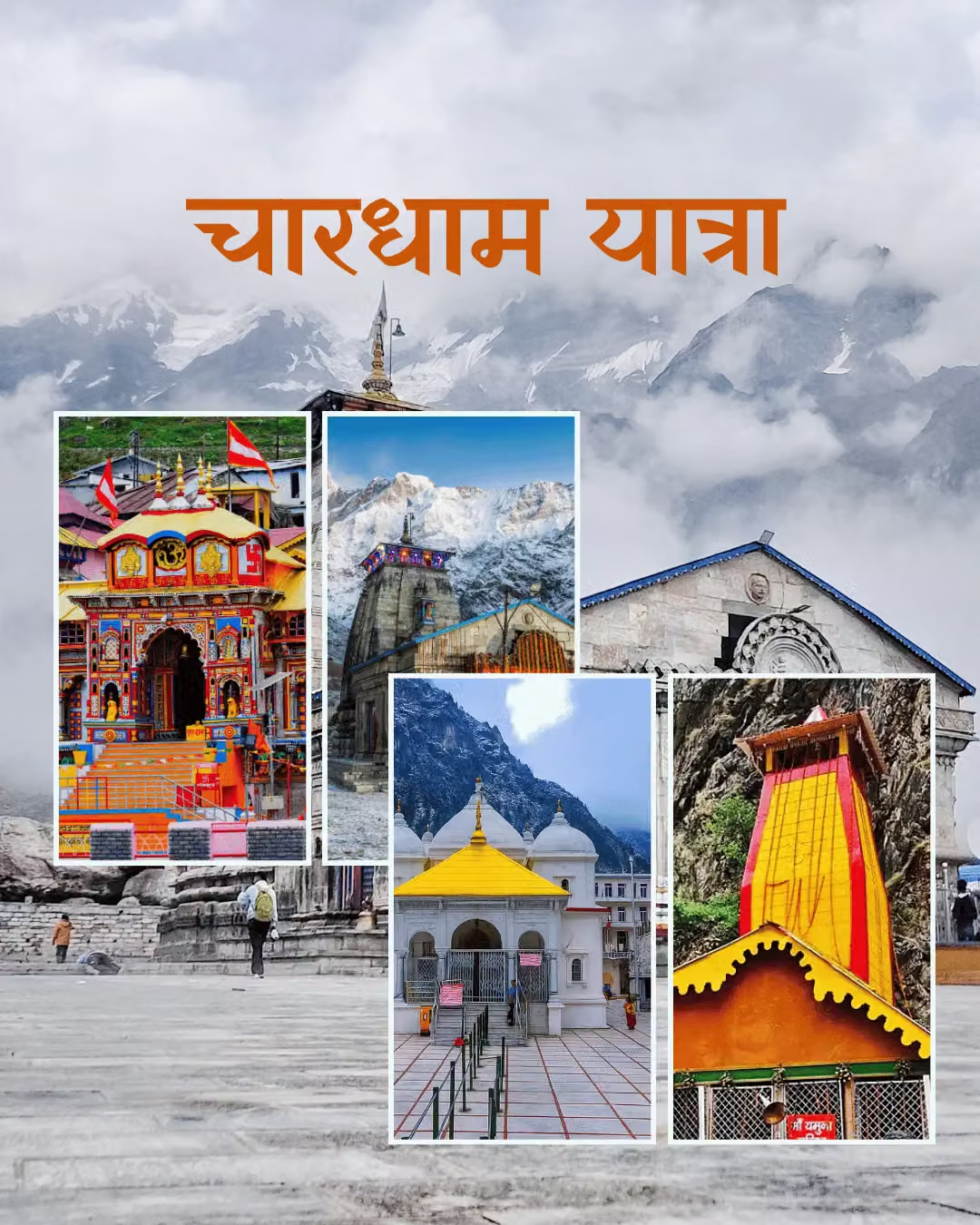
You might be interested in these yatras

Who should think twice
- Complete first-timers with no fitness base: If your last trek was a single-day hill station walk or an easy day hike, Roopkund is a significant jump — not impossible, but you’d need real training time first.
- Anyone with unmanaged cardiac or respiratory conditions: Underlying heart, lung or blood pressure conditions need a doctor’s clearance before attempting any trek above 14,000 feet.
- Anyone who’s never trekked in sub-zero conditions: Roopkund’s high camps are genuinely cold, and the summit push happens in low temperatures with wind exposure — this isn’t the trek to test your cold tolerance for the first time.
The honest verdict
Roopkund rewards preparation more than it punishes inexperience. A moderately fit first-timer who trains properly for 6 to 8 weeks will likely have an easier time than an experienced trekker who shows up without conditioning. Difficulty here is less about technical skill and more about sustained effort at altitude — which is exactly the kind of challenge you can train for in advance, rather than one you either have or don’t.
How Roopkund compares to other Uttarakhand treks
Difficulty grading only means something in context, so here’s where Roopkund sits against treks people commonly compare it to. Kedarkantha (12,500 ft, 4–5 days) is the classic beginner Himalayan trek — gentle gradients, shorter daily distances, and a summit day that’s demanding but brief. Brahmatal (12,250 ft, 5–6 days) sits a step up, with more sustained daily walking but similar peak altitude. Har Ki Dun (11,700 ft, 6–7 days) is valley-based and relatively gentle despite its length. Roopkund, by contrast, gains more total altitude than any of these, runs longer at 8 days, and asks for two separate 7–8 hour days back-to-back in its second half. If you’ve comfortably completed any of those three, Roopkund is a reasonable next step. If you haven’t trekked at all, we’d suggest one of those first.
Building confidence before you book
If you’re unsure whether you’re ready, there’s a simple way to test yourself before committing to a batch: complete a full week of the training plan we outline in our fitness guide — the 8 km-in-under-an-hour benchmark plus a 2 km run — and see how your body responds two days later. Genuine soreness that resolves within 48 hours is normal and expected. Persistent joint pain, breathlessness at rest, or an inability to complete the distance at all are signals worth taking seriously and addressing with more preparation time, not something to push through on the actual trek.
It’s also worth talking to your trek leader honestly during the pre-departure briefing about your fitness level and any concerns — this isn’t a competency test, it’s information that helps them plan pacing and keep an eye on you specifically during the harder days. The trekkers who struggle most on Roopkund are rarely the ones who admitted uncertainty upfront; they’re the ones who overstated their fitness and got caught out on Day 6.
| Plan your training: We’ve written a full 6–8 week Roopkund Trek fitness and training guide — worth reading before you commit to a batch. And the complete itinerary, cost and dates are here → Roopkung Trek Package Details. |