
Treks by
₹15,500per person
Roopkund is the trek people mention when they want to talk about something more than a nice view. We take you to a glacial lake sitting at 16,499 feet in the Chamoli district of Uttarakhand, right under the Trishul massif, where the ice has been quietly guarding a few hundred human skeletons for centuries. Locals call it Mystery Lake. Trekkers call it one of the most rewarding — and demanding — Himalayan treks in India.
This isn't a walk to a viewpoint and back. Over eight days from Rishikesh, we move through oak and rhododendron forest, onto the open bugyals (alpine meadows) of Aali and Bedni, past a small temple at Kalu Vinayak, and up a final stretch of loose scree and old snow to the rim of the lake itself. Trishul, Nanda Ghunti and a wall of unnamed Garhwal peaks stay in view for most of the second half of the trek.
We run this as a moderate-to-difficult trek, and we mean that: it suits trekkers who already have a multi-day Himalayan trek behind them, or who are training seriously for their first one. If you want the honest version of what each day looks like — distance, altitude gain, where you sleep — the itinerary below is exactly how our teams run it on the ground, batch after batch.
Lohajung to Didna: The trail climbs out of Lohajung through dense oak and rhododendron forest before Kuling village gives you your last close look at everyday hill life on the route.
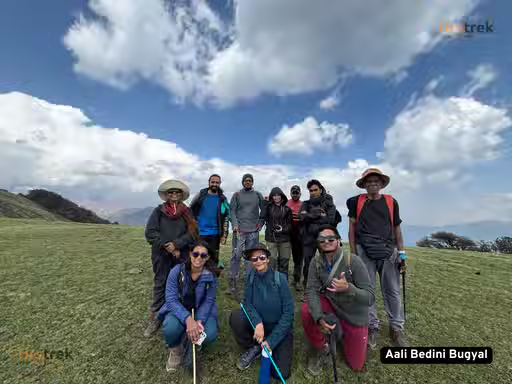
Ali Bugyal: One of the largest high-altitude meadows in Uttarakhand — a wide, rolling grassland at over 12,000 feet with the first full view of the Trishul range.
Bedni Bugyal: A quieter, more intimate meadow than Aali Bugyal, often used by trekking and mountaineering courses for training — you'll understand why the moment you see it.
Kalu Vinayak: A small stone shrine at roughly 14,000 feet, marking the point where the trail turns from meadow-walking into proper high-altitude trekking.
Bhagwabasa to Roopkund: The final push — cold, thin air, loose rock and, in the early season, snowfields — before the lake itself comes into view.
The Skeleton Lake mystery: Skeletal remains, some over 800 years old, are visible around the lake bed when the ice recedes. Genetic studies published in 2019 traced the remains to more than one population group and more than one time period, and the cause of death is still debated among researchers.
Junargali Pass (optional): Weather and route conditions allowing, we push a short distance further to this ridge for one of the widest panoramas on the entire trek.
Trek Leader's Tip Layer your clothing rather than relying on one heavy jacket — temperatures on this route swing from warm forest trails to well below freezing at Bhagwabasa within the same day.
Our standard route runs Lohajung → Didna → Ali Bugyal → Bedni Bugyal → Patar Nachauni → Bhagwabasa → Roopkund, with an optional push to Junargali Pass, before descending via Wan back to Lohajung. It's the classic, most-walked line to the lake, and the one our Chamoli-based team knows best — established campsites at every stage, reliable water sources, and a descent route (via Wan) that's different from the ascent, so you see new terrain both ways.
Roopkund Trek cost depends on the package you choose — where your journey starts, whether Rishikesh transfers are included, and whether you add the Junargali Pass extension. Every FirstTrek package covers the trekking essentials in the inclusions table above; batch-specific pricing and seat availability are confirmed at the time of booking.
| Package | Inclusion Level | Price / Person |
|---|---|---|
| Base Camp to Base Camp (Ex-Lohajung) | Trek only — without Rishikesh transfers | ₹12500/Person |
| Ex-Rishikesh (Standard) |
Full package with Rishikesh pickup & drop |
₹15500/Person |
| Ex-Rishikesh + Junargali Pass Extension |
Standard package with the optional pass push |
₹20500/Person |
Every part of this trek sits inside Nanda Devi's territory. Revered across Garhwal and Kumaon as the daughter of the mountains, the goddess is believed to leave her maternal home in Nauti village once every twelve years and travel roughly 280 km on foot toward Mount Trishul and Homkund, guided by a four-horned ram, in the Nanda Devi Raj Jat — a pilgrimage so demanding it's often called the Himalayan Mahakumbh. That route runs directly past Roopkund, and the lake's local name, the folklore attached to it, and even a campsite on our own itinerary trace back to the same story: local legend holds that a king from Kanauj, Raja Jasdhaval, brought a pregnant queen, servants and dancing girls on a pilgrimage to honour the goddess, disturbing her sanctuary with music and celebration along the way. Furious, Nanda Devi is said to have turned the dancers to stone — which is why the campsite you'll pass on Day 4 and Day 6 is called Patar Nachauniya, or "dancing stones" — before sending down a storm of hailstones described in local folk song as hard as iron, killing the rest of the party where they stood. The people who study this region professionally take the legend seriously as evidence, not just colour. William Sturman Sax, the American anthropologist who wrote Mountain Goddess: Gender and Politics in a Himalayan Pilgrimage after walking the Raj Jat himself in the 1980s, has long argued that the Roopkund story can't be separated from the wider Nanda Devi pilgrimage tradition — the route, the taboos, and the songs sung along the way all point back to the same sacred geography. Dr. Data Ram (D.R.) Purohit, the Rudraprayag-based folklorist and Sangeet Natak Akademi awardee who has spent decades documenting Garhwal's oral traditions, is regularly credited as the regional authority on the Nanda Devi Raj Jat and the folk songs tied to it — the same body of oral tradition that a 2004 National Geographic-backed expedition drew on when it matched the centuries-old hailstorm story against skull fractures found on the Roopkund remains. Science and folklore rarely agree this closely, which is a large part of why this particular trek stays lodged in people's memory long after the last descent to Lohajung.
Status update — July 2026: On 20 July 2026, the Supreme Court set aside the 2018 Uttarakhand High Court order that had banned overnight camping on bugyals, including Ali and Bedni. After eight years of restriction, Roopkund's classic meadow-camping route is fully permitted again — which is why FirstTrek is running live batches through August, September and October 2026.
The route runs through reserved forest land in the Chamoli district, and every trekker needs a forest permit before entering — our team handles registration and permit fees as part of your package. You'll just need a valid photo ID (Aadhaar, passport or driving licence) and to fill in basic health and emergency-contact details at the forest check-post near Lohajung.
Pickup and drop-off are both at Natraj Chowk, Rishikesh — 5:00 AM departure, roughly 7:00 PM return on Day 8. If you're travelling from outside Rishikesh, plan to arrive the evening before; Rishikesh is well connected by rail (Haridwar/Rishikesh stations) and by road from Delhi (approx. 6–7 hours), and Jolly Grant Airport, Dehradun is the nearest airport, about 45 minutes from Natraj Chowk.
Choose from our upcoming departure dates. Book early to secure your spot.
20 seats remaining
20 seats remaining
20 seats remaining
20 seats remaining
₹15,500
per person
₹18,500
Save ₹2,500 on transport!
Trek will be managed by
FirstTrek's Team Lohajung