
Treks by
May to June: Pleasant summer weather, suitable for travel and pilgrimage. September to October: Post-monsoon season offers clear skies and comfortable temperatures.
By Road: Pandukeshwar is located on the National Highway 7 (Rishikesh–Badrinath route), approximately 18 km from Joshimath and 23 km from Badrinath. Regular buses and taxis operate from Rishikesh, Haridwar, and Dehradun to Joshimath. From Joshimath, shared jeeps or taxis are available to Pandukeshwar. By Rail: The nearest railway stations are: Rishikesh: Approximately 274 km away. Dehradun: Approximately 302 km away. By Air: The closest airport is Jolly Grant Airport in Dehradun, about 290 km from Pandukeshwar.
{}
1,920 meters
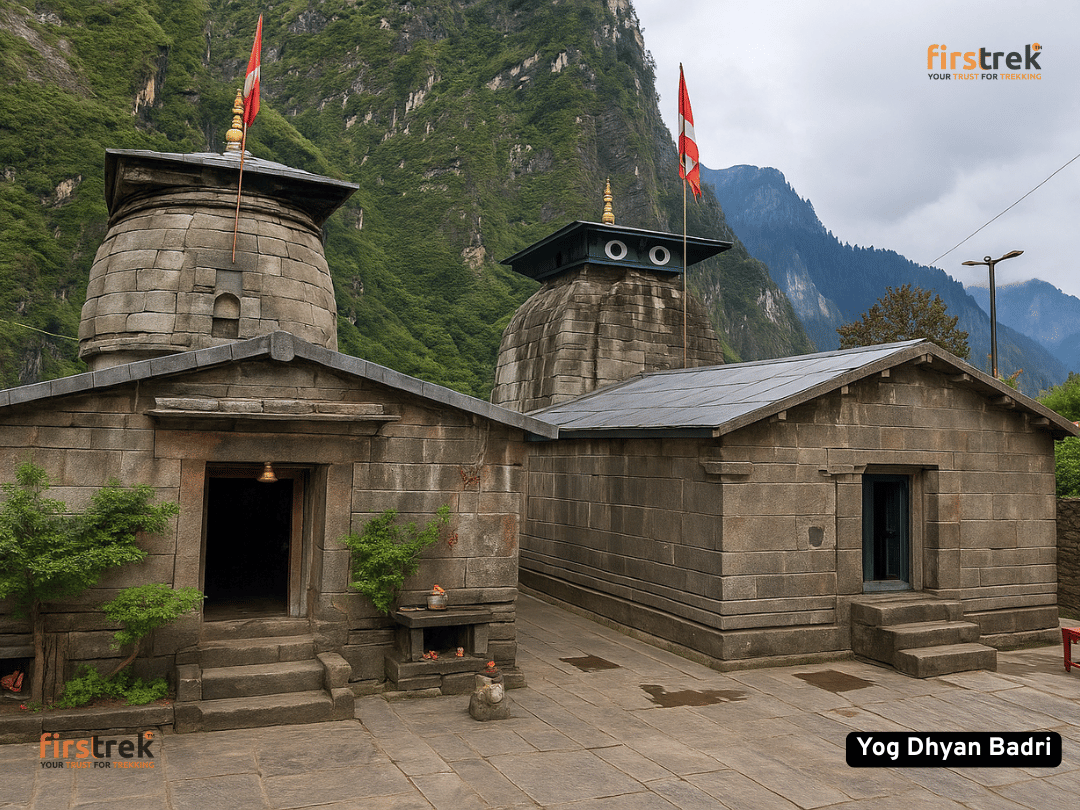
Yog Dhyan Badri, also known as Yogadhyan Badri, is a revered Hindu temple situated in Pandukeshwar village, approximately 24 kilometers from Joshimath in Uttarakhand, India. Perched at an altitude of around 1,920 meters (6,300 feet) in the Garhwal Himalayas, this temple is one of the five sacred shrines collectively known as the Panch Badri, all dedicated to Lord Vishnu.
Yog Dhyan Badri is one of the sacred Panch Badri temples located in the quaint village of Pandukeshwar, near Joshimath in the Chamoli district of Uttarakhand. This revered shrine is dedicated to Lord Vishnu and holds immense mythological and spiritual significance in Hinduism.
The temple is believed to have been established by King Pandu, the father of the Pandavas from the epic Mahabharata. It is said that Pandu meditated here to atone for his sins and installed the bronze idol of Lord Vishnu in a yogic (meditative) posture—hence the name Yog Dhyan Badri. The idol is life-sized and showcases Lord Vishnu in deep meditation, a rare depiction not commonly seen in other temples.
Yog Dhyan Badri, located in Pandukeshwar near Joshimath, is one of the seven sacred Sapta Badri temples dedicated to Lord Vishnu. According to legend, King Pandu, father of the Pandavas from the Mahabharata, meditated here to atone for his sins and installed a bronze idol of Lord Vishnu in a meditative posture, giving the temple its name—Yog Dhyan Badri. The temple is believed to be as ancient as the main Badrinath shrine and holds significant historical importance. Architecturally, the temple showcases a blend of styles. Art historian Nachiket Chanchani notes that the dome of Yog Dhyan Badri exhibits similarities with temples built in Tamil Nadu during the 800–1000 AD period, suggesting Dravidian influences. Additionally, adjacent to Yog Dhyan Badri is the Vasudeva temple, constructed in the late 9th century in the Nagara Latina style, prevalent in the Central Himalayas.