
Treks by
March to June: Mild spring and early summer – ideal for peaceful visits, walking the kora path, and attending teachings. September to November: Post-monsoon clarity with cool temperatures, perfect for spiritual retreats and scenic experiences. December to February: Cold, but serene with fewer tourists and snow-capped surroundings. Avoid: July and August due to heavy monsoon rainfall, landslides, and low visibility.
By Air: The nearest airport is Gaggal (Kangra) Airport, about 20 km from McLeod Ganj. Taxis and cabs are easily available from the airport. By Train: The closest major railhead is Pathankot Railway Station, approximately 90 km away. From Pathankot, buses and taxis take around 3–4 hours to reach McLeod Ganj. By Road: McLeod Ganj is well-connected by public and private buses from Delhi, Chandigarh, Amritsar, and Manali. From Dharamshala, it's a short 20-minute ride uphill to the town center. The temple complex is walkable from the main square.
{}
1,770 meters
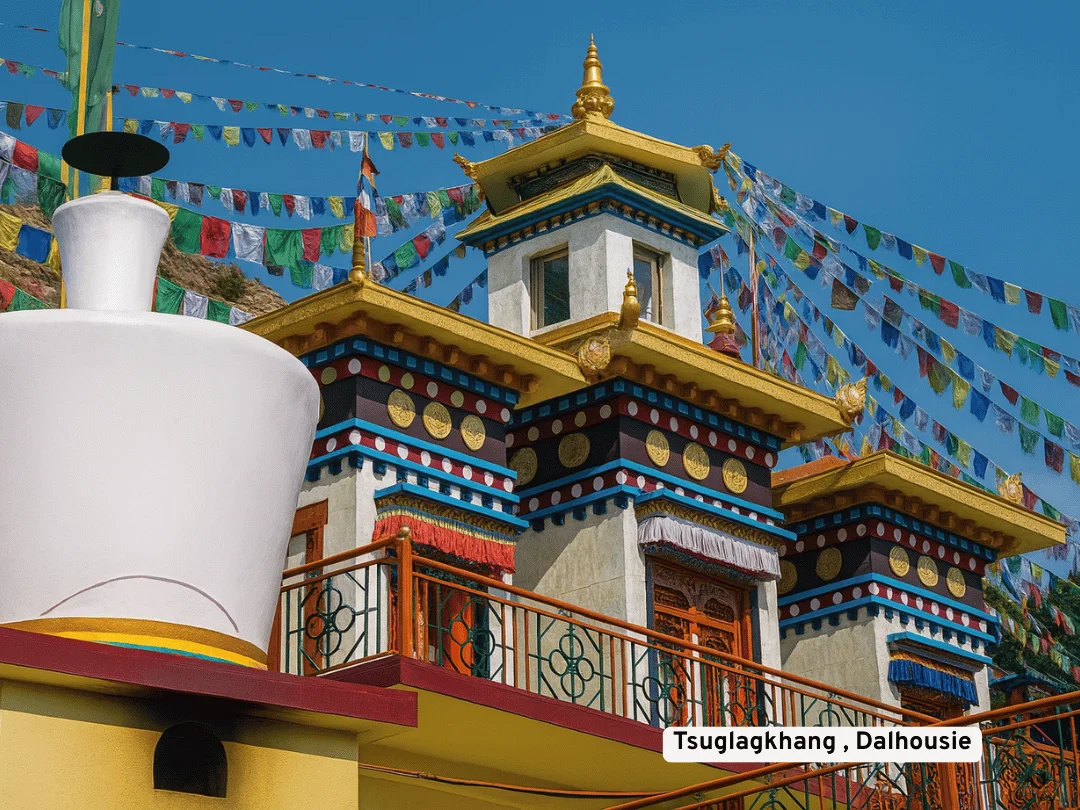
Tsuglagkhang is the main temple complex of Tibetan Buddhism in exile, located in McLeod Ganj, Dharamshala, Himachal Pradesh. It serves as the spiritual center for the Tibetan community and is home to the residence of His Holiness the 14th Dalai Lama, the Namgyal Monastery, and a Tibetan museum. Open to all visitors, Tsuglagkhang offers a peaceful space for meditation, prayer, and cultural learning. The complex features large statues of Buddha Shakyamuni, Avalokiteshvara, and Guru Padmasambhava, surrounded by prayer wheels and fluttering flags. It is not only a religious site but also a symbol of Tibetan resilience, peace, and global spiritual dialogue.
Tsuglagkhang is the main temple complex of Tibetan Buddhism in exile, located in McLeod Ganj, Dharamshala, Himachal Pradesh. Built in 1960, it serves as the official spiritual center for the Tibetan government-in-exile and is closely associated with His Holiness the 14th Dalai Lama, whose official residence lies within the complex.
More than just a temple, Tsuglagkhang is a living symbol of peace, resilience, and global spirituality, attracting thousands of visitors each year—from pilgrims and monks to scholars, tourists, and spiritual seekers.
The Main Temple Hall
At the heart of Tsuglagkhang lies a simple yet powerful prayer hall, housing statues of Buddha Shakyamuni, Avalokiteshvara (Chenrezig), and Guru Padmasambhava (Guru Rinpoche). The space is open to all and radiates peace, often filled with the hum of mantras and the slow turning of prayer wheels.
Namgyal Monastery
Known as the personal monastery of the Dalai Lama, Namgyal is a hub for Buddhist learning, ritual practices, and monastic life. Monks engage in daily debates, prayers, and meditation.
Tibetan Museum
Located at the entrance of the complex, the museum presents the story of Tibet’s occupation, cultural heritage, and the exile movement through photographs, personal accounts, and multimedia exhibits.
Kora Path (Circumambulation Trail)
A sacred walking path that circles the complex, lined with colorful prayer wheels, mani stones, and fluttering Tibetan flags. Pilgrims and visitors perform kora here as a meditative and spiritual practice.
Tsuglagkhang is more than a place of worship—it’s a symbol of cultural survival and peaceful resistance. It has hosted public teachings by His Holiness the Dalai Lama and continues to serve as a platform for interfaith dialogue, compassion-based education, and spiritual unity.
Visitors often leave feeling deeply moved by the calm, respectful energy of the place, where tradition blends seamlessly with open-minded global spirituality.
Location: McLeod Ganj, Dharamshala, Himachal Pradesh
Altitude: Approx. 1,770 meters
Nearest Airport: Gaggal (Kangra) – ~20 km
Nearest Railway Station: Pathankot – ~90 km
Getting There: Easily accessible by foot from McLeod Ganj’s main market area
The Tsuglagkhang Temple Complex was established in 1960, shortly after His Holiness the 14th Dalai Lama fled Tibet following the Chinese invasion in 1959. Upon being granted asylum by the Government of India, the Dalai Lama made McLeod Ganj his permanent residence, and Tsuglagkhang became the spiritual and political hub of the Tibetan exile community. The temple complex was modeled after the original Tsuglagkhang in Lhasa, Tibet, and represents not only the continuity of Tibetan Buddhism in exile but also the peaceful endurance of a displaced culture.