
Treks by
April to June: Pleasant weather with clear views, ideal for temple visits and sightseeing September to November: Post-monsoon freshness, fewer tourists, and excellent visibility Avoid: July–August (due to heavy monsoon rains and landslides) and peak winter months (Dec–Feb) if you are not comfortable with snow and cold
By Road: Reach Sonprayag, which is well-connected to Rishikesh, Haridwar, and Rudraprayag by bus or taxi From Sonprayag, Triyuginarayan is just 12 km away by road or via a light trek. Private taxis or shared jeeps are available By Train: Nearest Railway Station: Rishikesh (~220 km) Buses and cabs are available from Rishikesh to Sonprayag By Air: Nearest Airport: Jolly Grant Airport, Dehradun (~245 km) From the airport, hire a cab or take a bus via Rishikesh and Rudraprayag to reach Sonprayag
{}
1,980 meters
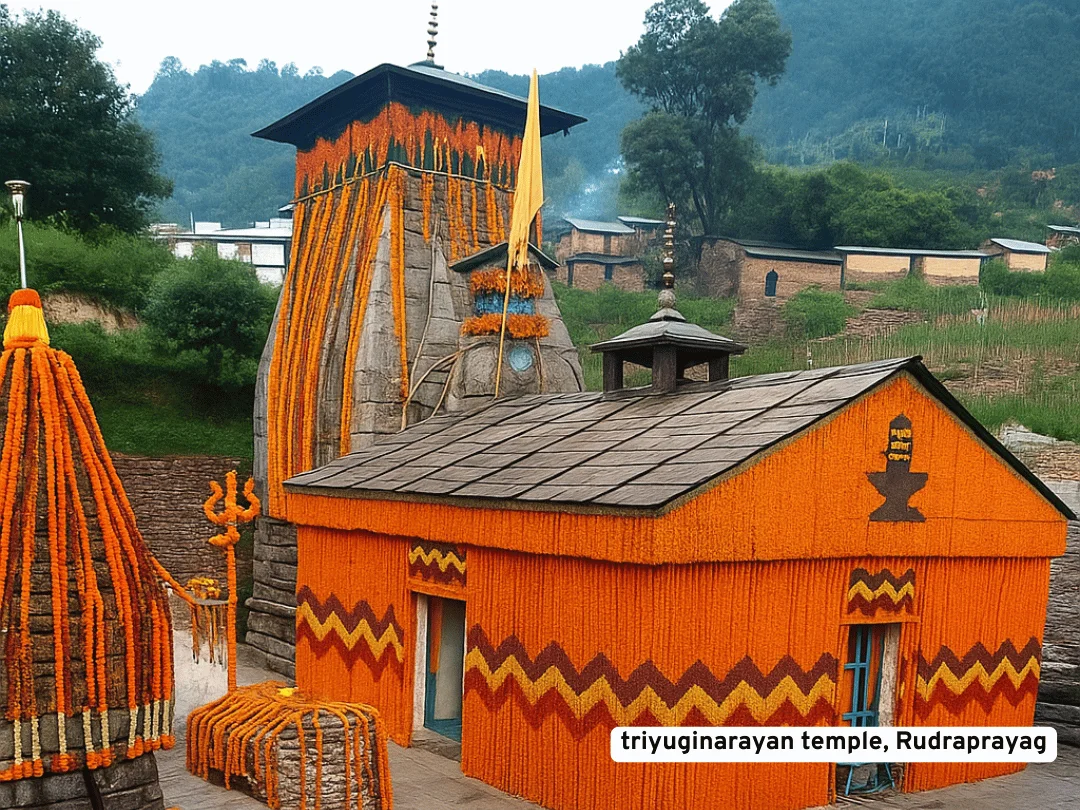
Triyuginarayan is a sacred village in the Rudraprayag district of Uttarakhand, famous as the mythological wedding site of Lord Shiva and Goddess Parvati. The temple here, dedicated to Lord Vishnu, is believed to have witnessed their celestial marriage, with the eternal flame (Akhand Dhuni) in front of the temple said to have been burning since that divine event. Surrounded by lush mountains and offering panoramic views of the Himalayas, Triyuginarayan is not only a spiritual destination but also a popular spot for traditional Hindu weddings and pilgrimage.
Triyuginarayan is a sacred village located in the Rudraprayag district of Uttarakhand, perched at an altitude of around 1,980 meters above sea level. This serene Himalayan hamlet is best known as the mythological wedding site of Lord Shiva and Goddess Parvati, an event believed to have been witnessed by Lord Vishnu himself.
According to Hindu scriptures, it was in Triyuginarayan that the celestial wedding of Shiva and Parvati took place, after Goddess Parvati’s long penance to win Lord Shiva’s heart. The presiding deity of the temple here is Lord Vishnu, who is said to have played the role of Parvati’s brother during the wedding ceremony, while Lord Brahma performed the rituals as the priest.
The most sacred feature of this temple is the Akhand Dhuni (eternal flame), believed to have been burning continuously since the divine wedding—hence the name "Triyugi" (three yugas/eras) + "Narayan" (a name for Lord Vishnu). Devotees collect ash from this flame as a sacred souvenir, believed to bring blessings for marital harmony and spiritual protection.
The Triyuginarayan Temple resembles the Kedarnath Temple in architectural style, built with gray stone and nestled amid dense forests and lofty Himalayan peaks. The temple complex houses three sacred kunds (ponds):
Rudra Kund – Used for bathing
Brahma Kund – Used for ceremonial sips
Vishnu Kund – Used for worship and rituals
The temple is modest yet powerfully spiritual, and the natural surroundings add to its charm, making it a popular site for destination weddings, spiritual retreats, and heritage tourism.
Triyuginarayan offers captivating views of snow-clad mountains, lush forests, and meadows. It lies close to:
Kedarnath (25 km by trek or 12 km from Sonprayag via road): One of the most important Jyotirlingas of Lord Shiva
Gaurikund: The starting point for the Kedarnath trek
Sonprayag: A nearby base town for travelers and pilgrims
Guptkashi: Known for the Vishwanath Temple and Manikarnika Kund
In recent years, Triyuginarayan has gained popularity as a spiritual wedding destination, with couples choosing to marry in front of the eternal flame, seeking divine blessings for lifelong companionship. The Uttarakhand government has promoted it as a wedding tourism site, and simple wedding arrangements can be made through local temple authorities or private planners.
Triyuginarayan is steeped in Hindu mythology and is considered one of the most sacred sites in Uttarakhand. According to legends from the Puranas, this is the very place where Lord Shiva and Goddess Parvati were married, witnessed by Lord Vishnu and performed by Lord Brahma as the priest. The temple that stands today is dedicated to Lord Vishnu, who is believed to have presided over the celestial wedding. The most iconic symbol of this event is the Akhand Dhuni—an eternal flame that has supposedly been burning since the time of the divine marriage. Pilgrims believe that the ashes from this flame bless newlyweds with long-lasting love and devotion. The site has been revered for centuries, and its significance predates many other temples in the region, linking it directly to the Kedarkhand section of ancient scriptures.