
Treks by
March to June and September to November
By Air: The nearest functional airport is Pantnagar Airport (approx. 250 km). The Naini Saini airstrip (5 km from Pithoragarh town) is mostly used for government and utility flights. By Rail: The closest railway station is Tanakpur (approx. 138 km), connected to major cities like Delhi and Bareilly. By Road: Pithoragarh is well connected by road to cities like Haldwani, Almora, and Champawat. Regular buses and shared taxis are available. From the town center, the fort is about a 15-minute uphill walk or a short drive.
{}
1,640 meters
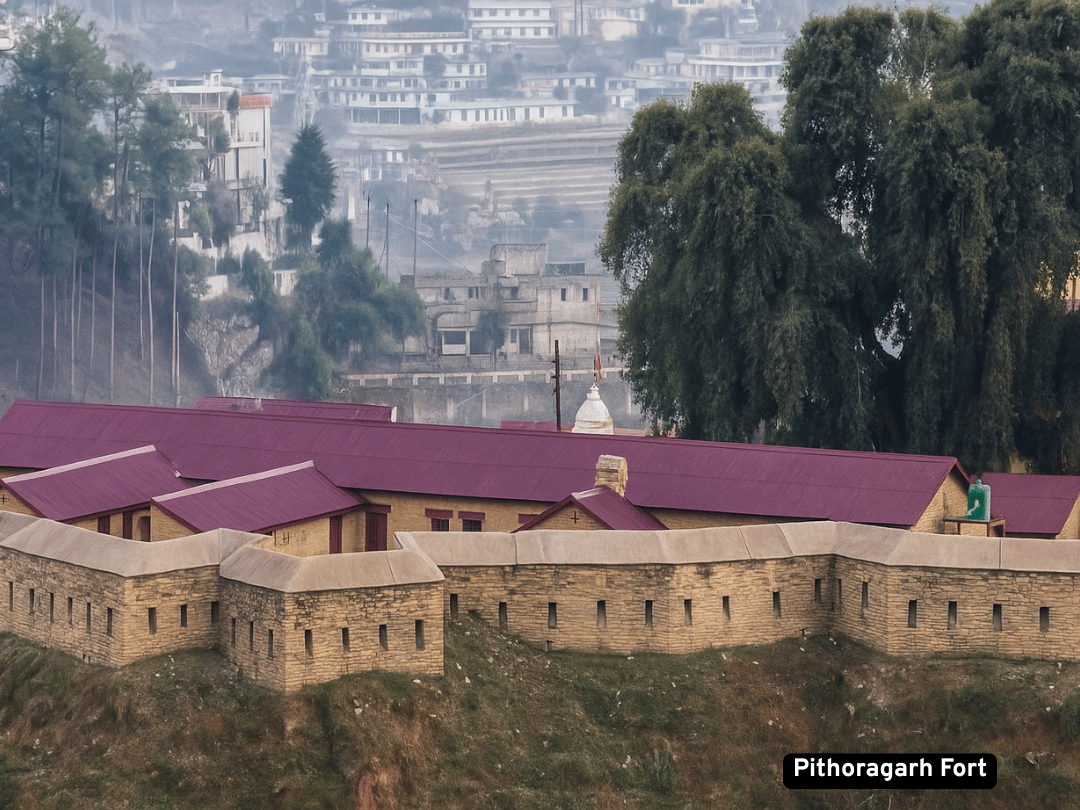
Pithoragarh Fort, perched atop a hill in the town of Pithoragarh, Uttarakhand, is a historic monument built during the Chand dynasty and later fortified by the Gorkhas. Offering panoramic views of the Soar Valley and surrounding Himalayan peaks, the fort reflects a blend of medieval architecture and colonial history. It is a serene spot for history lovers, photographers, and nature enthusiasts alike.
Pithoragarh Fort, also known as London Fort, stands as a historical sentinel on the western edge of Pithoragarh town in Uttarakhand. Built in the 18th century by the Chand dynasty, the fort was later captured and fortified by the Gorkhas in 1789. It remained under British control after the Anglo-Nepalese war and was used as an administrative center, earning it the nickname “London Fort.”
Perched at an altitude of approximately 1,640 meters, the fort offers mesmerizing views of the Soar Valley and snow-clad Himalayan peaks such as Nanda Devi, Panchachuli, and Trishul. The fort’s architecture includes thick stone walls, arched gateways, old storage chambers, and watchtowers, reflecting strategic design suited for defense.
Pithoragarh Fort was originally constructed in the late 18th century by the Chand dynasty ruler, King Prithwi Gusain. Strategically built on a hilltop overlooking the Soar Valley, the fort served as a defensive stronghold and administrative center. In 1789, the Gorkhas captured the region and fortified the structure, transforming it into a military post. Later, during the British colonial era, the fort was renamed “London Fort” and served as a tehsil headquarters. Today, the fort stands as a symbol of the region’s layered history, representing Chand rule, Gorkha expansion, and British administration.