
Treks by
Spring (March to May): Pleasant weather with blooming wildflowers paints a picturesque backdrop. Summer (June to August): Lush greenery and comfortable temperatures make it a good time for sightseeing. However, the monsoon season begins in July, leading to occasional rains. Autumn (September to November): The monsoon retreats, revealing clear skies and captivating mountain views. This is considered the peak season for tourism. Winter (December to February): The Himalayas transform into a winter wonderland, with snow-capped peaks and crisp air. However, some roads leading to Guptkashi might be closed due to snowfall.
By Road: Guptkashi is well-connected by motorable roads to major cities like Haridwar and Rishikesh. Buses and taxis ply regularly on this route. By Train: The nearest railway station is located in Rishikesh, around 144 kilometers from Guptkashi. From Rishikesh, taxis or shared cabs can be availed to reach Guptkashi. By Air: The nearest airport is Jolly Grant Airport in Dehradun, approximately 200 kilometers from Guptkashi. From the airport, one can hire a taxi or take a bus to reach Guptkashi. From Guptkashi to Narayan Koti Temple: The temple complex is located about 3–4 kilometers from Guptkashi on the Rudraprayag–Gaurikund highway. It can be reached by a short drive or a leisurely walk.
{}
1,319 meters
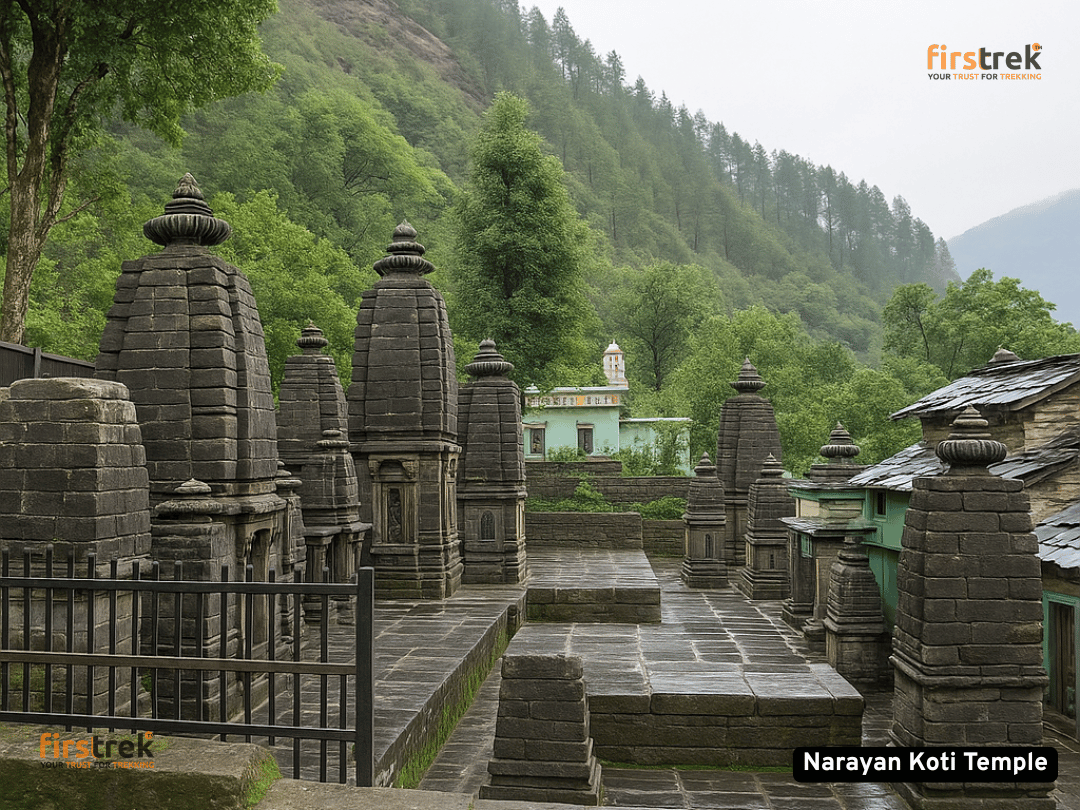
The Narayan Koti Temple complex, located approximately 3–4 kilometers from Guptkashi on the Rudraprayag–Gaurikund highway, is a significant yet lesser-known spiritual site in Uttarakhand. This ancient complex comprises 29 surviving temples, down from the original 360, and is believed to have been constructed before or around the 9th century AD. The temples are primarily dedicated to Lakshmi Narayana, a form of Lord Vishnu, and include unique shrines for each of the Navagrahas—the nine celestial bodies in Hindu astrology: Sun, Moon, Mars, Mercury, Jupiter, Venus, Saturn, Rahu, and Ketu.
The Narayan Koti Temple, also known as the Narayan Koti Mandir Samuh, is a revered complex of ancient temples situated approximately 3–4 kilometers from Guptkashi on the Rudraprayag–Gaurikund highway in Uttarakhand, India. Perched at an elevation of about 1,319 meters above sea level, this sacred site offers a serene environment for spiritual reflection amidst the Himalayan foothills.
Narayan Koti Temple, located near Guptkashi in the Rudraprayag district of Uttarakhand, is believed to date back to the 9th century AD or earlier. Originally comprising 360 temples, today only 29 structures survive, still echoing the grandeur of ancient Indian architecture and spiritual dedication. The temple complex is primarily dedicated to Lakshmi Narayan (a manifestation of Lord Vishnu) and also houses shrines for the Navagrahas (nine celestial deities). According to legend, when the Pandavas were on their journey seeking forgiveness from Lord Shiva, Lord Krishna is said to have manifested here to console them after they were unable to meet Shiva.