
Treks by
March to June and September to November are ideal for visiting. These months offer clear skies, pleasant weather, and stunning views of the Dhauladhar mountain range.
By Air: The nearest airport is Gaggal Airport (Kangra), about 35 km away. Taxis are easily available. By Train: The closest railway station is Pathankot, around 90 km from the site. From there, you can hire a taxi or take a bus. By Road: Well connected by road, Masroor can be reached via taxi or bus from Dharamshala (45 km) or Kangra town (40 km). The last stretch includes a slight uphill drive, suitable for most vehicles.
{}
790 meters
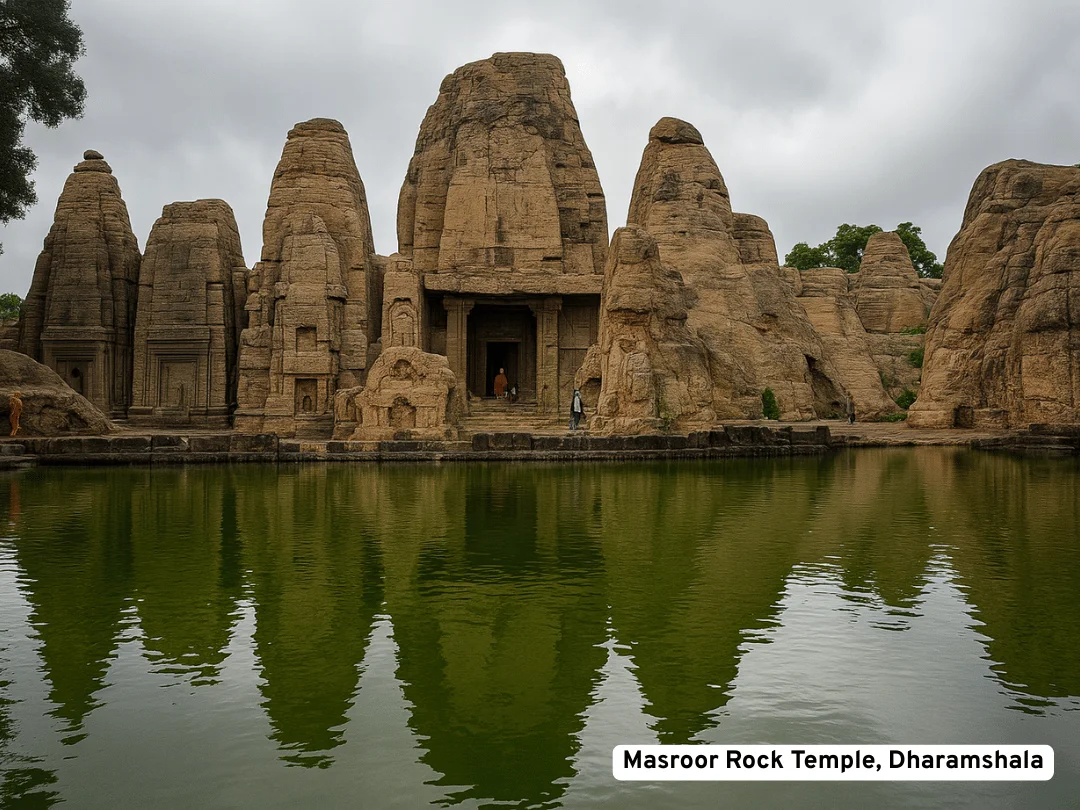
The Masroor Rock Cut Temples, located near Kangra in Himachal Pradesh, are a stunning group of 15 monolithic temples carved from a single sandstone rock. Dating back to the 8th century, these temples are dedicated to Lord Shiva, Vishnu, and other deities. Often called the "Ellora of the North," the site is admired for its intricate carvings and its reflection in the nearby sacred pond, creating a breathtaking visual symmetry.
Pradesh, are an ancient architectural wonder carved entirely from a single rock formation. This complex of 15 temples stands majestically on a hilltop, offering panoramic views of the Kangra Valley and the snow-capped Dhauladhar ranges.
Believed to date back to the 8th century, the temples are dedicated mainly to Lord Shiva, though images of Vishnu, Rama, and other deities are also present. The central shrine, known as Thakurdwara, houses the idols of Rama, Lakshmana, and Sita—carved intricately into the sanctum walls. Scholars believe that the site was originally meant to represent a miniature Mount Kailash, the mythical abode of Lord Shiva.
What makes this site exceptional is that it is North India's only known example of monolithic rock-cut Hindu temples. Its resemblance to the famous Ellora caves has earned it the title "Ellora of the North." Despite weathering centuries of natural forces, including a damaging earthquake in 1905, much of the structure’s fine carvings and architectural detailing remain intact.
In front of the temple complex lies a sacred tank that beautifully mirrors the structures—a serene and symbolic reflection that enhances its spiritual aura. Though not as widely visited as other sites in Himachal, Masroor remains a hidden gem for history lovers, architecture enthusiasts, and spiritual seekers.
The Masroor Rock Cut Temples are believed to have been built during the 8th century CE, possibly under the rule of the Katoch dynasty. The architecture reflects strong influences of North Indian Nagara style, with elaborate shikharas (towers) and finely chiseled stone carvings. While the main shrine houses idols of Lord Rama, Lakshmana, and Sita, scholars suggest that the original dedication may have been to Lord Shiva, given the temple's layout and structure. Though partially damaged by the devastating Kangra earthquake of 1905, much of its grandeur still endures.