
Treks by
March to June: Pleasant weather with blooming flora and ideal trekking conditions. September to November: Post-monsoon clarity with cool breezes and scenic views. Avoid: July–August due to landslides and slippery trails from monsoon rains, and December–February due to heavy snowfall.
By Air: Nearest Airport: Bhuntar Airport (Kullu) – approx. 40 km from Malana. From Bhuntar, take a taxi or local bus to Jari or Malana dam. By Road: Drive or bus to Jari (Kasol–Manikaran route), then take a private cab or start your trek from Malana Gate. Road access ends near Malana Power Project. From there, a 4 km trek leads to the village. By Rail: Nearest major railway station: Joginder Nagar (around 135 km), but road travel is more convenient.
{}
2,650 meters
Malana Village, nestled in the Parvati Valley of Himachal Pradesh, is one of the oldest democracies in the world. Known for its unique customs, language (Kanashi), and social structure, Malana remains culturally distinct and spiritually rich. Surrounded by snow-capped peaks and pine forests, this remote village also attracts trekkers and curious travelers seeking isolation, beauty, and a glimpse into an ancient way of life untouched by modernity.
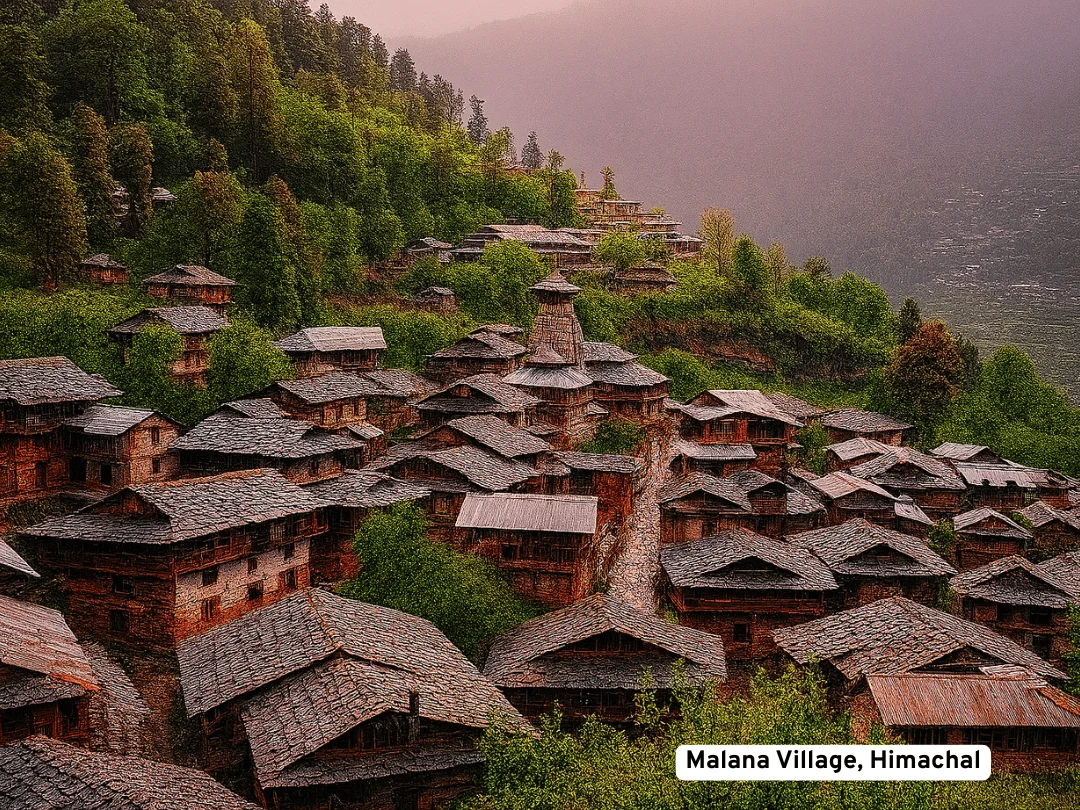
Malana is a secluded ancient village located in the Parvati Valley of Himachal Pradesh, India. Perched at an altitude of around 2,650 meters (8,700 feet), this Himalayan hamlet is renowned for its distinct culture, democratic governance, and mystical aura. Often referred to as one of the oldest republics in the world, Malana operates under its own local administrative system called the “Kanun of Malana,” believed to be older than even the Indian Constitution.
Encircled by the towering peaks of Chandrakhani and Deo Tibba, the village offers mesmerizing landscapes filled with dense deodar forests, stone paths, and traditional wooden houses. What sets Malana apart is its strict social code—outsiders are not allowed to touch the villagers, their houses, or temples. This preservation of purity stems from their belief of being descendants of Alexander the Great’s soldiers, although there’s no concrete historical proof of this claim.
The people of Malana speak their own dialect called Kanashi, which is not spoken or understood in the rest of the valley. The lifestyle is simple yet self-sustained, relying primarily on agriculture, sheep-rearing, and now, tourism. In recent years, the village has also garnered attention for its association with Malana Cream, a world-famous variety of cannabis grown in the area.
Despite being remote and traditional, Malana has embraced controlled tourism, especially among trekkers and cultural explorers who arrive via the scenic Jari–Malana trek or the more challenging Rasol and Chandrakhani Pass routes.
Whether you are a nature lover, a trekking enthusiast, or a seeker of ancient traditions, Malana offers an experience unlike anywhere else—mystical, peaceful, and deeply rooted in heritage.
Malana is one of the oldest democracies in the world, with a unique system of self-governance that predates modern India. The villagers believe they are descendants of Alexander the Great's army, which settled here centuries ago. The village remained isolated for centuries, preserving its ancient customs and socio-political system. The local administration follows the "Kanashi" code of law, said to be sacred and unchangeable.