
Treks by
Spring to Early Summer: March to June offers pleasant weather, ideal for pilgrimages and exploration. Post-Monsoon to Early Winter: September to November provides clear skies and comfortable temperatures. Avoid: July to August due to heavy monsoon rains making roads slippery and travel challenging
By Road: From Dehradun: Approximately 180 km via Mussoorie–Purola–Naugaon route; takes around 6 hours. From Chakrata: About 95 km via Tuini; approximately 4 hours. By Rail: Nearest Railway Station: Dehradun Railway Station (approx. 181 km away). By Air: Nearest Airport: Jolly Grant Airport, Dehradun (approx. 207 km away). Local Transport: Taxis and buses are available from Dehradun and Chakrata to Hanol.
{}
1,050 meters
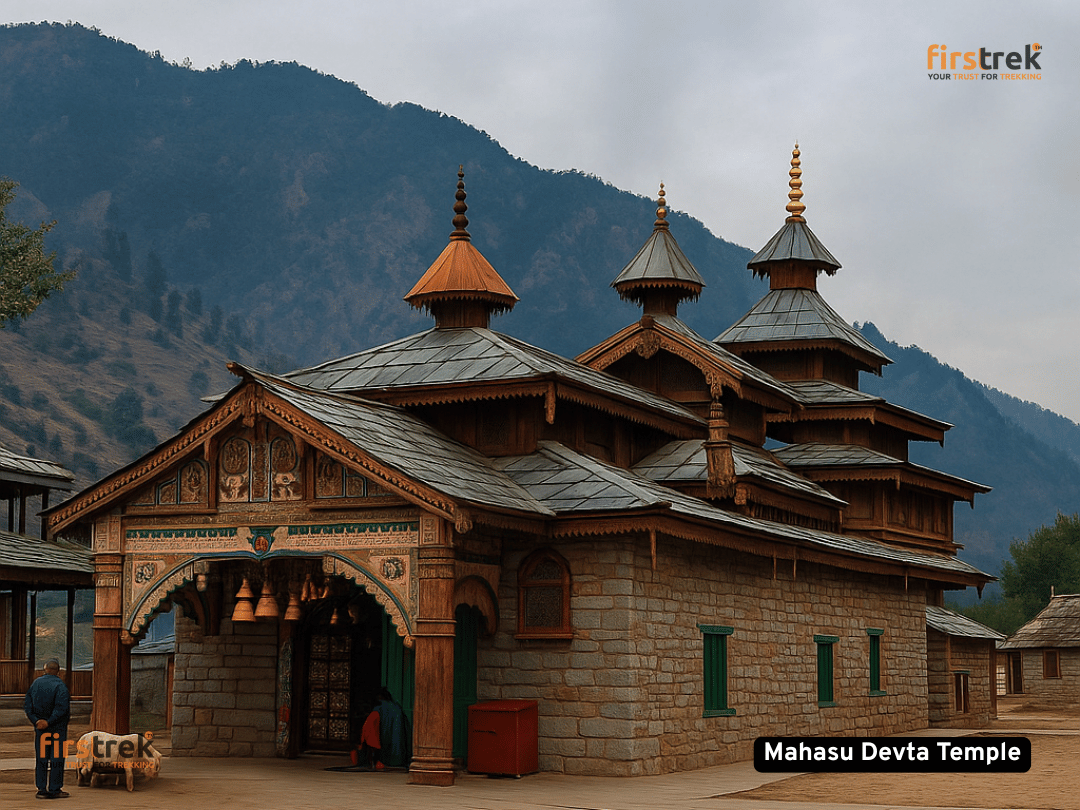
The Mahasu Devta Temple, nestled in the serene village of Hanol in Uttarakhand's Dehradun district, is a revered 9th-century shrine dedicated to Mahasu Devta, an incarnation of Lord Shiva. Situated on the eastern bank of the Tons River, this temple stands as a testament to the region's rich cultural and spiritual heritage.
Nestled in the mystical village of Hanol on the eastern bank of the Tons River, the Mahasu Devta Temple is a sacred 9th-century shrine dedicated to Mahasu Devta, believed to be an incarnation of Lord Shiva and the chief deity of the Jaunsar-Bawar region. This ancient wooden temple is not only an architectural marvel but also a spiritual epicenter for devotees across Uttarakhand and Himachal Pradesh.
According to legend, the region was once tormented by a demon named Kirmir. A devout Brahmin named Huna Bhatt prayed for deliverance, and four divine brothers — Botha, Pavasi, Vasik, and Chalda — appeared to destroy the demon. These four forms of Mahasu Devta became the guardians of the region, with Botha Mahasu worshipped as the chief deity in Hanol.
The Mahasu Devta Temple in Hanol, Uttarakhand, is a significant spiritual and cultural landmark. According to local legends, the temple's origins trace back to the 9th century. It is believed that a Brahmin named Huna Bhatt prayed to Lord Shiva to rid the region of a demon named Kirmir who was terrorizing the area. In response, Lord Shiva manifested as Mahasu Devta, who, along with his brothers—Botha, Pavasi, Vasik, and Chalda—defeated the demon and restored peace. The temple was constructed in the Kath-Kuni architectural style, characterized by the harmonious use of wood and stone, and is now maintained by the Archaeological Survey of India.