
Treks by
May to June: Pleasant weather, ideal for road travel and clear views September to early November: Crisp skies, great for photography and sightseeing Avoid: December to April (extreme cold, snow-blocked roads) and July–August (monsoon, landslide risk)
By Air: Nearest Airport: Shimla Airport (~300 km) From Shimla, take a private taxi or bus to Reckong Peo or Pooh, then continue to Khab by road By Rail: Nearest Railway Station: Shimla Railway Station (~300 km) Requires road journey from Shimla to reach Khab By Road: Khab is connected via National Highway 5 (NH-5) Route: Shimla → Rampur → Reckong Peo → Pooh → Khab Public buses and shared taxis operate up to Pooh or Nako. Private vehicles recommended for flexibility
{}
2,500 meters
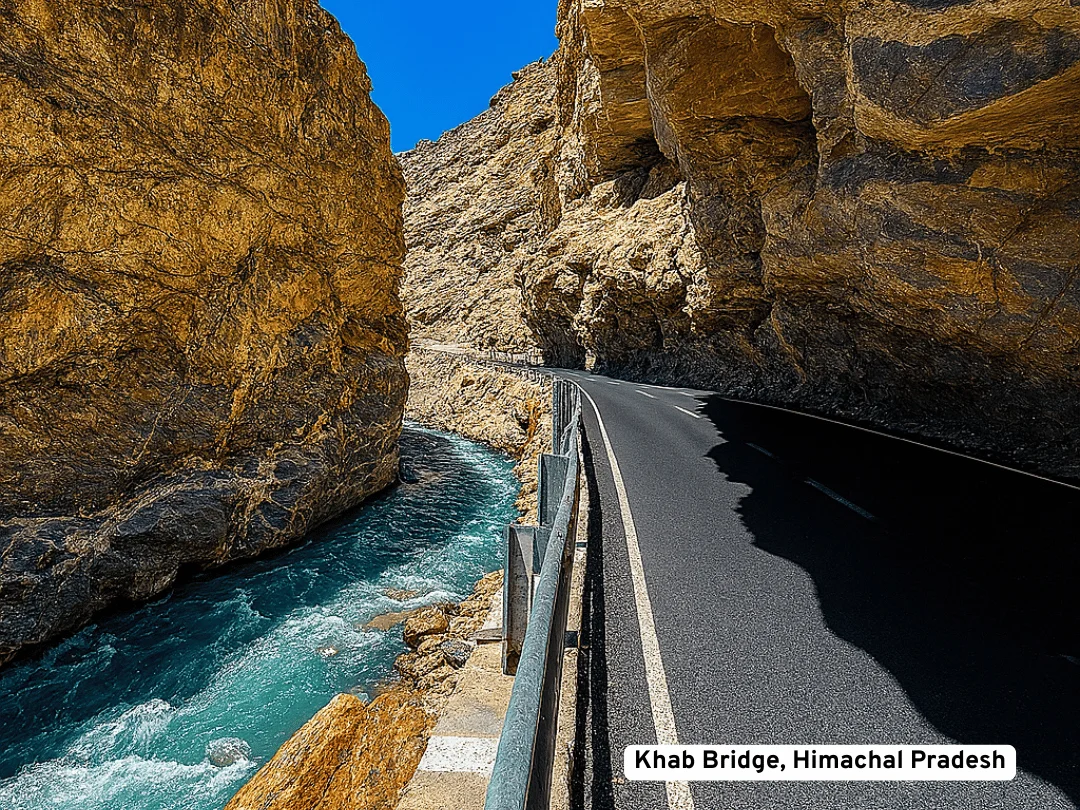
Khab Bridge is a stunning engineering structure located in the Kinnaur district of Himachal Pradesh, where the Spiti River merges into the Sutlej River. It lies at the intersection of two contrasting landscapes—lush green Kinnaur and the stark, barren valley of Spiti. This bridge not only connects the two regions physically but also marks the cultural transition between the Indo-Tibetan influenced Spiti and the more traditional Himachali villages of Kinnaur. Surrounded by high mountains and deep river gorges, Khab Bridge offers a mesmerizing view of the river confluence and is often a stopover for travelers heading to Tabo, Nako, or Kalpa. It's a symbol of natural beauty and strategic importance, especially on the journey to the remote corners of Himachal.
Khab Bridge is a striking landmark in the Kinnaur district of Himachal Pradesh, built near the confluence of the Sutlej and Spiti Rivers. Located at an altitude of around 2,500 meters, this bridge lies at a critical geographic and cultural junction where the lush green Kinnaur valley meets the cold, arid terrain of Spiti.
Positioned on National Highway 5, Khab Bridge connects Pooh and Nako to the lower towns like Rampur and Kalpa. It also serves as an important gateway into the remote Spiti Valley, especially for travelers coming from Shimla side. Once you cross this bridge, the landscape dramatically shifts—from pine forests and terraced fields to barren cliffs and vast riverbeds.
The Sutlej River, one of the longest rivers in India, flows in from Tibet and meets the Spiti River, a smaller, glacier-fed stream from the high mountains of Spiti. This confluence at Khab is a natural marvel, where the brownish waters of the Sutlej mix with the clearer flow of the Spiti, creating a striking contrast.
From the bridge or the nearby viewpoints, one can clearly observe this union of two powerful Himalayan rivers, making Khab an unforgettable stop for photographers, nature lovers, and explorers.
Khab Bridge is not just scenic—it is also strategically vital. The road it supports is part of the Indo-Tibetan Border Road network, crucial for military access to forward posts near the international border. In winter, when high-altitude passes like Kunzum La are closed due to snow, this route via Khab becomes the only motorable lifeline to Spiti Valley.
The bridge’s location, near the ancient Tibetan trade routes, also holds historic relevance. Traders once crossed these paths with wool, salt, and barley, linking the remote valleys with Tibet and other Himalayan communities.
Nako Village & Lake – Serene village 15 km from Khab
Pooh Village – A quiet apple-growing village just 17 km away
Leo & Chango Villages – Small settlements reflecting Kinnauri culture
Reo Purgil Viewpoint – From Khab, on a clear day, you can spot this massive Himalayan peak
Khab Bridge stands not just as a feat of engineering, but as a symbolic gateway between two worlds—green Kinnaur and rugged Spiti. Whether you're an adventurer heading to Spiti or a curious traveler exploring Himachal's raw beauty, Khab is a place that commands a moment of pause and wonder.
Khab, located at the confluence of the Spiti and Sutlej Rivers, holds historical significance as a strategic and cultural crossroads in the Himalayas. Historically, it was part of ancient trade routes connecting Tibet and India, used by traders carrying salt, wool, barley, and other goods. The region around Khab has witnessed centuries of movement—of traders, pilgrims, and monks—making it a silent witness to Indo-Tibetan exchanges. Today, Khab Bridge symbolizes not just connectivity between roads and rivers, but also between cultures—bridging the lush, fertile Kinnaur region and the barren, mystical land of Spiti.