
Treks by
April to June (Summer): Pleasant weather with clear views; ideal for sightseeing and photography September to November (Autumn): Crisp air and beautiful fall colors, fewer crowds Avoid: December to February due to snowfall and road closures
By Air: Nearest Airport: Shimla Airport (~225 km) or Bhuntar Airport near Kullu (~245 km) From the airport, taxis or buses are available to Sangla By Train: Nearest Railway Station: Shimla (~230 km) Continue by road via Rampur and Karcham By Road: Kamru Fort is just 2 km uphill from Sangla town in the Kinnaur district Well-connected by road via NH-5 Route: Shimla → Narkanda → Rampur → Karcham → Sangla → Kamru A short, scenic 15–20 minute walk from Sangla Bazaar leads to the fort through traditional village lanes and wooden houses.
{}
2,600 meters
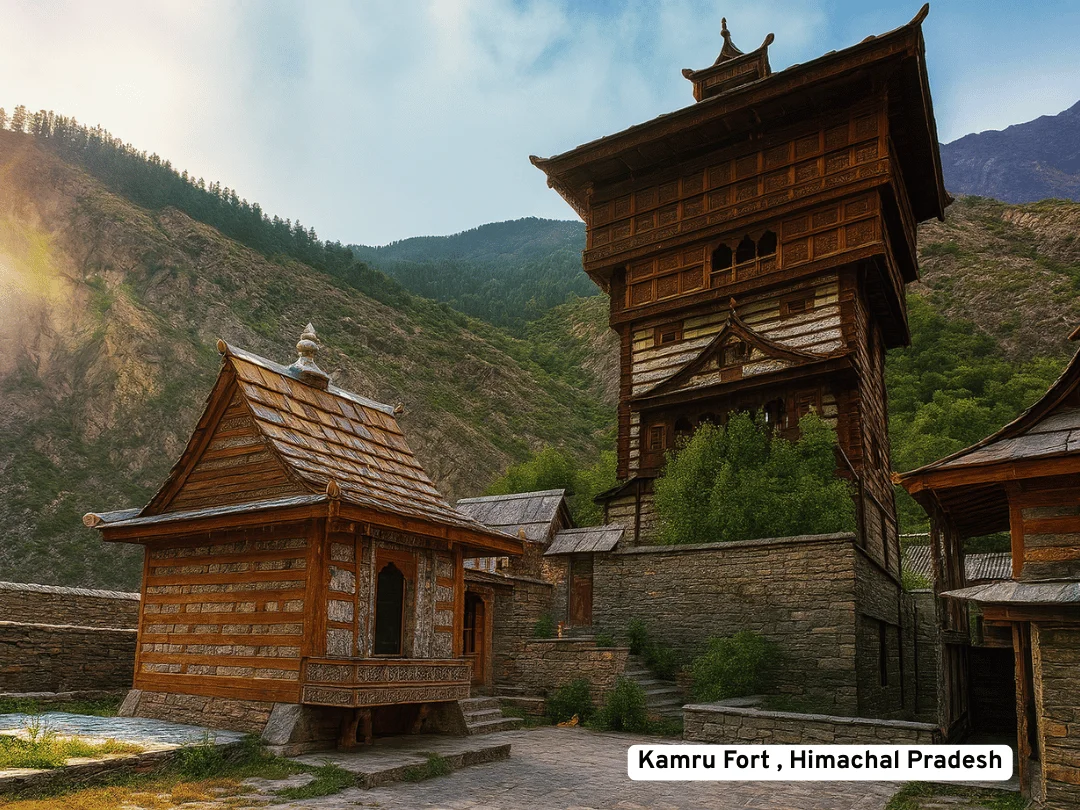
Located at the edge of Sangla village in Himachal Pradesh, Kamru Fort is a historic marvel nestled at an altitude of around 2,600 meters. Surrounded by snow-clad peaks and lush apple orchards, the fort stands tall as a symbol of Kinnaur’s royal legacy. Believed to be over 800 years old, it once served as the capital of the Bushahr dynasty, one of the most prominent kingdoms of the region. Built in traditional Himachali architecture, the multi-tiered wooden structure is crowned by a sacred shrine dedicated to Goddess Kamakhya Devi. The entrance is guarded by a wooden balcony and a fluttering of Buddhist prayer flags, reflecting the spiritual blend of Hindu and Buddhist cultures in the valley.
Kamru Fort is a magnificent blend of history, spirituality, and architecture, perched above the quaint village of Sangla in Kinnaur district, Himachal Pradesh. Located at an altitude of approximately 2,600 meters, this ancient wooden fort is surrounded by snow-capped mountains, thick pine forests, and rolling apple orchards, making it one of the most scenic historic sites in the Indian Himalayas.
Kamru Fort is built in the traditional Kath-Kuni style—a distinctive Himalayan architectural form using stone and interlocking wooden beams without cement. The fort stands tall with multiple tiers, resembling a small towered castle. Its wooden balconies, narrow stairways, and stone base make it a visually striking structure that has withstood the test of time and harsh mountain weather.
At the very top, a sacred temple dedicated to Goddess Kamakhya Devi sits inside the fort. The idol is said to have been brought from Assam, and entry to the inner sanctum is restricted to the temple priest, maintaining the sanctity of the space.
Kamru Fort was once the capital of the Bushahr Kingdom, one of the most powerful princely states in the western Himalayas. Long before Rampur Bushahr became the administrative hub, Kamru served as the royal seat and played a key role in governing the Kinnaur region. The fort is still used symbolically for royal coronation rituals, upholding centuries-old traditions.
The fort’s strategic location along the old Indo-Tibetan trade route made it not just a royal residence but also a checkpoint for traders and spiritual travelers.
Kamru Fort is more than a historical monument—it's a living cultural site. It embodies a harmonious blend of Hindu and Buddhist traditions, which is evident in the presence of Buddhist prayer flags, nearby monasteries, and Hindu shrines within the premises. Locals regard the fort as a divine protector of the Sangla Valley, and rituals are performed here to seek blessings and protection from deities.
For History Lovers: A gateway into Kinnaur’s royal past
For Spiritual Seekers: A serene place of devotion amidst natural beauty
For Photographers & Nature Enthusiasts: Panoramic views of the Baspa River valley, lush orchards, and towering mountains
For Cultural Explorers: A rich mix of folklore, festivals, and architecture
Kamru Fort is believed to be over 800 years old and was once the capital of the Bushahr dynasty, a powerful princely state in the western Himalayas. Before the administration moved to Rampur, this fort served as the royal residence and court. The fort’s strategic position near the Indo-Tibetan trade route made it a crucial point of political and economic control. The architecture reflects both Himachali tradition and Tibetan influence, showcasing the cultural exchanges that happened over centuries. The fort is built in layers using stone and wood, following the Kath-Kuni style of construction. Over time, it has become both a historical monument and a sacred site, revered by locals and visitors alike.