
Treks by
March to June: Mild temperatures, clear weather—perfect for pilgrimage and sightseeing September to November: Post-monsoon freshness with a spiritual ambiance; ideal for Navratri visitors Avoid: July–August (heavy rainfall, landslide risk) and late December–January (extremely cold and sometimes inaccessible due to snow)
By Road: Kalimath is approximately 20 km from Guptkashi It is well connected via road from Rudraprayag, Kedarnath base towns, and Haridwar Taxis and local jeeps are available from Guptkashi and nearby towns By Train: Nearest Railway Station: Rishikesh (~210 km) Buses and taxis are available from Rishikesh to Guptkashi and onward to Kalimath By Air: Nearest Airport: Jolly Grant Airport, Dehradun (~235 km) From the airport, one can travel by road via Rishikesh and Rudraprayag
{}
1,800 meters
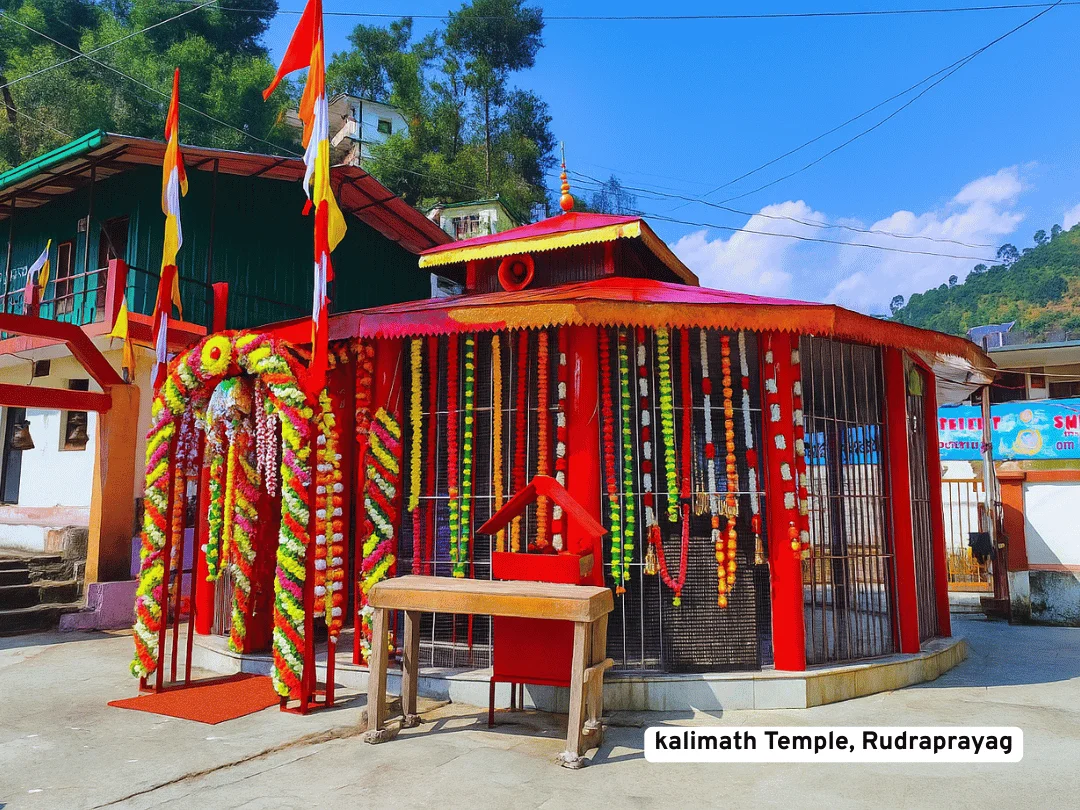
Kalimath Temple is a revered Shakti Peeth located in the Rudraprayag district of Uttarakhand. Dedicated to Goddess Kali, it is believed to be one of the few places where the goddess is worshipped in her most powerful form. Unlike other temples, the idol is not visible; instead, a silver plate marks the sanctum, believed to cover the spot where Kali vanished after slaying the demon Raktabija. Surrounded by the Mandakini River and snow-capped peaks, Kalimath is a deeply spiritual site, especially visited during Navratri when special tantric rituals are performed.
Kalimath Temple is one of the most revered Shakti Peethas in India, nestled in the Rudraprayag district of Uttarakhand at an altitude of approximately 1,800 meters. Dedicated to Goddess Kali, this temple holds deep mythological, spiritual, and tantric significance. It stands as a symbol of divine feminine power and protection, attracting devotees, seekers, and spiritual practitioners from across the country.
According to Hindu mythology, Kalimath is the sacred site where Goddess Kali annihilated the demon Raktabija during a cosmic battle. As the legend goes, after slaying him, Kali is believed to have merged into the earth at this very location. Unlike other temples, there is no idol of Kali in the sanctum. Instead, the sanctum is marked by a flat silver plate, placed over the holy spot where the goddess is said to have disappeared.
The temple also houses shrines dedicated to Goddess Laxmi and Goddess Saraswati, representing the unity of the Tridevi (three principal goddesses in Hinduism). Just a few meters uphill from Kalimath lies Kali Shila, a sacred rock believed to be the exact spot where Kali performed the slaying of Raktabija. Devotees often trek here as part of their spiritual journey.
Kalimath Temple is located on the banks of the Mandakini River, surrounded by scenic views of snow-clad Himalayan peaks, dense deodar forests, and meadows. The aura of the place is quiet, mystical, and profoundly spiritual. Many yogis and sadhaks (spiritual practitioners) consider Kalimath a powerful center for tantric practices and meditation, particularly during the Navratri festival.
The region’s untouched natural beauty, combined with the intense energy of the temple, makes Kalimath a perfect destination for spiritual reflection and pilgrimage.
What sets Kalimath apart is the night worship of the goddess, which is conducted in secret by the temple priests, especially during Navratri. No one except the head priest is allowed during this sacred nighttime ritual. It is believed that divine energy is so intense during these hours that it can only be handled by those trained in ancient tantric traditions.
Ashes from the rituals are considered highly auspicious and are distributed to devotees the following morning as prasadam.
Kalimath Temple is one of the 108 sacred Shakti Peethas mentioned in ancient Hindu scriptures. It is believed to be the exact spot where Goddess Kali, after slaying the demon Raktabija, disappeared into the earth. Unlike most temples where deities are represented with idols, Kalimath’s sanctum contains a flat silver plate that marks the sacred spot—making it a rare and mystical shrine. Historically, Kalimath has been a center of Tantric worship and Devi Sadhana for sages, yogis, and spiritual seekers. The temple's origins are lost in time but are closely connected to the Skanda Purana and Devi Mahatmya, which describe the power and presence of the goddess in this Himalayan region.