
Treks by
October to May – Pleasant weather ideal for temple darshan and wildlife safaris in Jim Corbett Peak festivals: Kartik Purnima (usually Nov–Dec) – temple is beautifully lit, fair takes place Navratri – special rituals and large gatherings .
By Road Located on NH‑12, about 14 km north of Ramnagar, and 10 km from the Corbett Park entrance Ramnagar is well-connected by buses and taxis to Delhi, Nainital, Haldwani, and Dehradun By Train Nearest station: Ramnagar Railway Station (code RMR) on the Moradabad–Ramnagar line. Direct trains from Delhi, Lucknow, Chandigarh, and Kolkata . By Air Closest airports: Pantnagar (~80 km) and Bareilly (~145 km). For international flights, Delhi IGI Airport is ~255 km away Final Stretch After reaching the riverbank, visitors cross a pedestrian bridge and climb about 60–90 steep steps to the shrine .
{}
18 meters
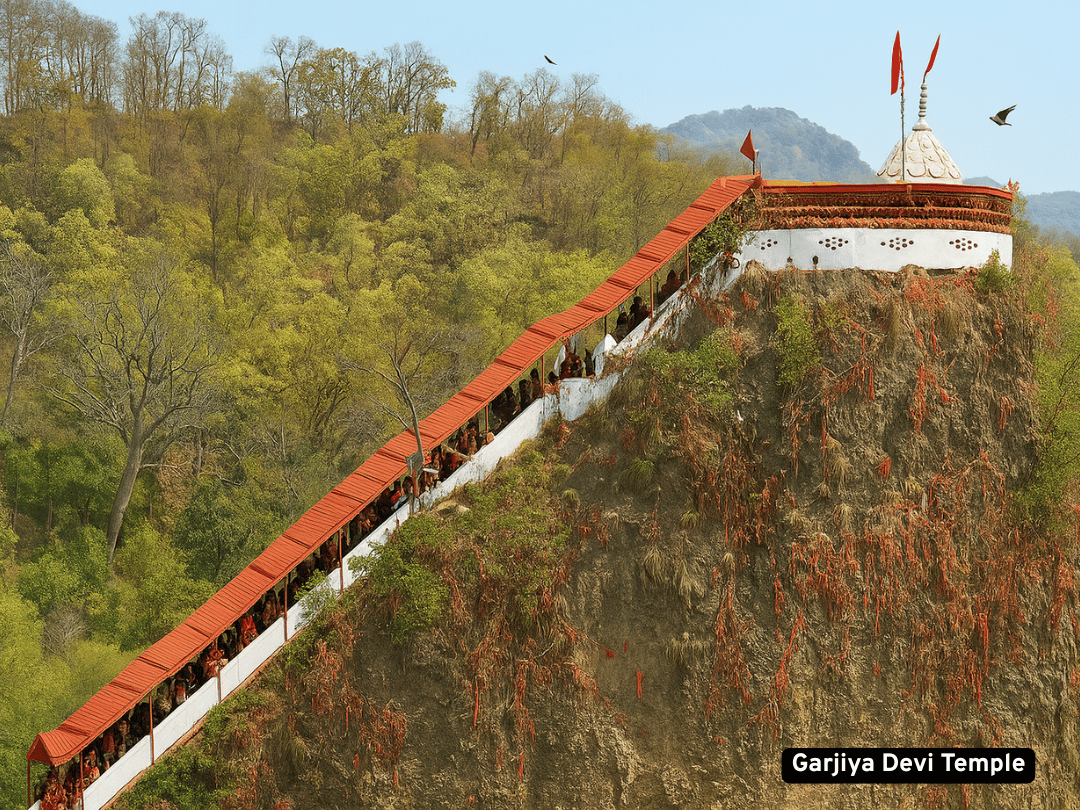
Garjiya Devi Temple is a prominent Hindu shrine located near Ramnagar, in the Nainital district of Uttarakhand, India. Perched dramatically on a large rock in the middle of the Kosi River, the temple is dedicated to Goddess Garjiya, an incarnation of Goddess Parvati. It is one of the most revered Shakti temples in the region and draws thousands of devotees every year, especially during the Kartik Poornima Mela.
Garjiya Devi Temple is one of the most famous temples in Uttarakhand, situated on a large rock in the middle of the Kosi River near Ramnagar. Dedicated to Goddess Garjiya (a form of Parvati), the temple holds immense religious significance for devotees, especially during Kartik Poornima, when thousands visit for holy darshan and a dip in the river.
The temple's unique positioning—surrounded by flowing waters and lush hills—adds to its mystical charm. To reach the sanctum, visitors cross a small bridge and climb around 60 steep stairs carved into the rock. The panoramic view of the Kosi River, forests, and distant Himalayan foothills offers both spiritual and scenic delight.
The temple is a 150+‑year‑old Shakti shrine, dedicated to Goddess Garjiya (Parvati), originally established by the first priest, Pt. Keshav Dutt Pandey, Inside the temple is a 9th-century black granite statue of Lakshmi Narayan, showcasing its historical roots Legends claim a saint halted a clay boulder during floods, forming the rock island where the temple now stands