
Treks by
October to March: Cool, pleasant weather ideal for sightseeing, photography, and nature walks. March to June: Mild summer temperatures make it suitable for morning visits and academic tours. Avoid: July–August due to heavy monsoon rain and humidity, which may limit outdoor exploration.
By Air: Jolly Grant Airport (around 30 km away) is the nearest airport. Taxis and app-based cabs are readily available to reach the FRI campus. By Train: The closest railway station is Dehradun Railway Station (~5 km). Autorickshaws and taxis are easily available from the station to FRI. By Road: FRI is well-connected via Dehradun’s public and private transport networks. Visitors can reach FRI by bus, taxi, or personal vehicle. It is situated on Chakrata Road, about 6 km from Clock Tower, the city center.
{}
640 meters
The Forest Research Institute (FRI) in Dehradun is one of India’s most prestigious institutions dedicated to forestry research and education. Established in 1906 during British rule, it is renowned for its grand Greco-Roman style architecture and sprawling 450-hectare campus. Surrounded by lush forests and botanical gardens, FRI houses multiple museums related to forestry, biodiversity, and wildlife. It also serves as a popular tourist attraction and film shooting location. With its scientific significance and natural beauty, FRI stands as a symbol of India’s commitment to environmental conservation and research.
The Forest Research Institute (FRI) in Dehradun is one of India’s oldest and most prestigious institutions in the field of forestry and environmental research. Established in 1906 under British colonial rule, the institute has played a pivotal role in shaping the country’s forestry policies and ecological conservation strategies. It operates under the Indian Council of Forestry Research and Education (ICFRE), Ministry of Environment, Forest and Climate Change, Government of India.
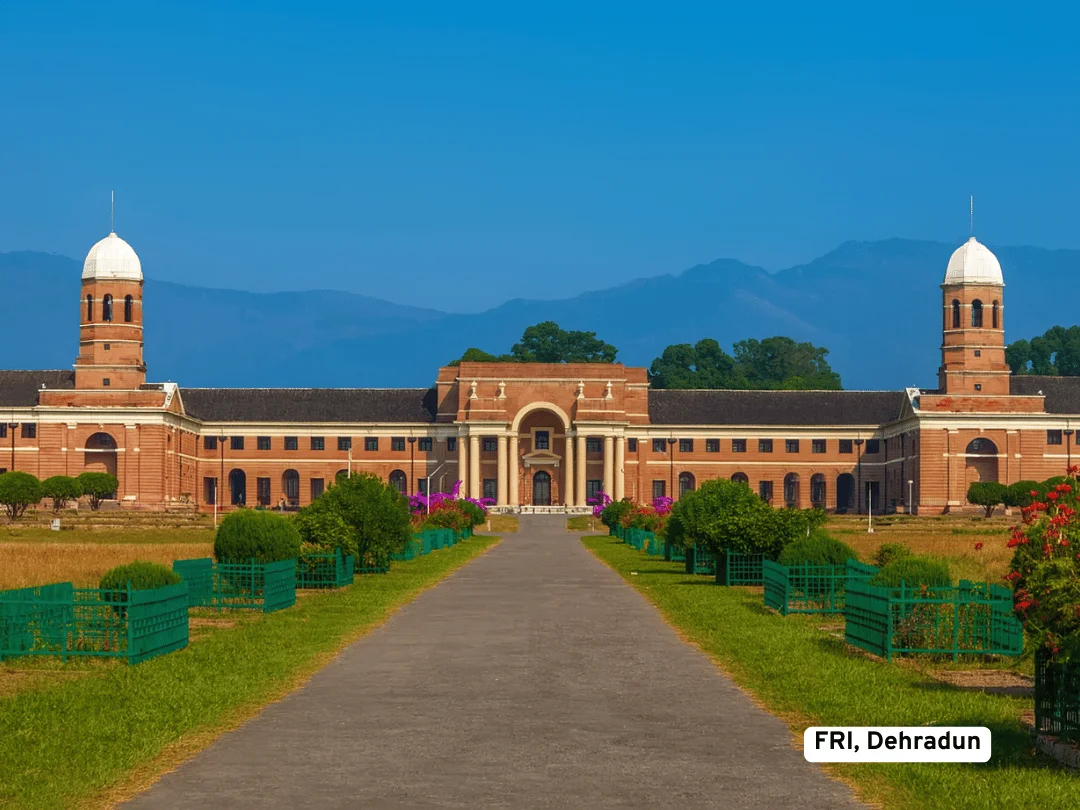
One of FRI’s most striking features is its magnificent Greco-Roman colonial architecture, which is often compared to grand European universities. The iconic red-brick building, completed in 1929, is spread across 450 hectares, making it one of the largest institutes of its kind in Asia.
The building is surrounded by expansive lawns, botanical gardens, and forested zones that create a serene and inspiring environment for research and education. The majestic corridors, symmetrical design, and lush green backdrop make it a popular location for filmmakers and tourists.
FRI is a centre of excellence in forestry education, offering M.Sc. and Ph.D. programs in subjects like:
Forestry
Environmental Management
Wood Science & Technology
Cellulose & Paper Technology
The institute is also known for its cutting-edge research in:
Forest conservation
Climate change
Silviculture
Biodiversity
Agroforestry and more
Its research directly supports sustainable forest management practices across India.
FRI is home to six museums that are open to the public, making it an educational and tourist attraction:
Pathology Museum – Showcasing diseases affecting trees and forests
Social Forestry Museum – Focused on community forestry and rural development
Silviculture Museum – Information on forest cultivation methods
Timber Museum – Featuring rare and important timber species
Non-Wood Forest Products Museum – Displaying products like resins, gums, and medicinal plants
Entomology Museum – Dedicated to forest insects and their ecological roles
FRI’s majestic architecture and scenic campus have made it a favorite location for Bollywood films such as Student of the Year, Rehnaa Hai Terre Dil Mein, and many others. It is also one of Dehradun’s top tourist spots, attracting thousands of visitors every month for guided tours, nature walks, and photography.
The Forest Research Institute (FRI) was established in 1906 during British colonial rule to serve as a premier institute for forestry research and training in India. Initially started as the Imperial Forest Research Institute, it was relocated to its current iconic campus in 1929. The architectural marvel, designed in Greco-Roman colonial style by architect C.G. Blomfield, is a testament to the importance the British placed on scientific forestry. Over the decades, FRI has evolved into a global center for excellence in forestry and environmental sciences. It continues to shape national forest policies, promote biodiversity conservation, and support climate resilience studies.