
Treks by
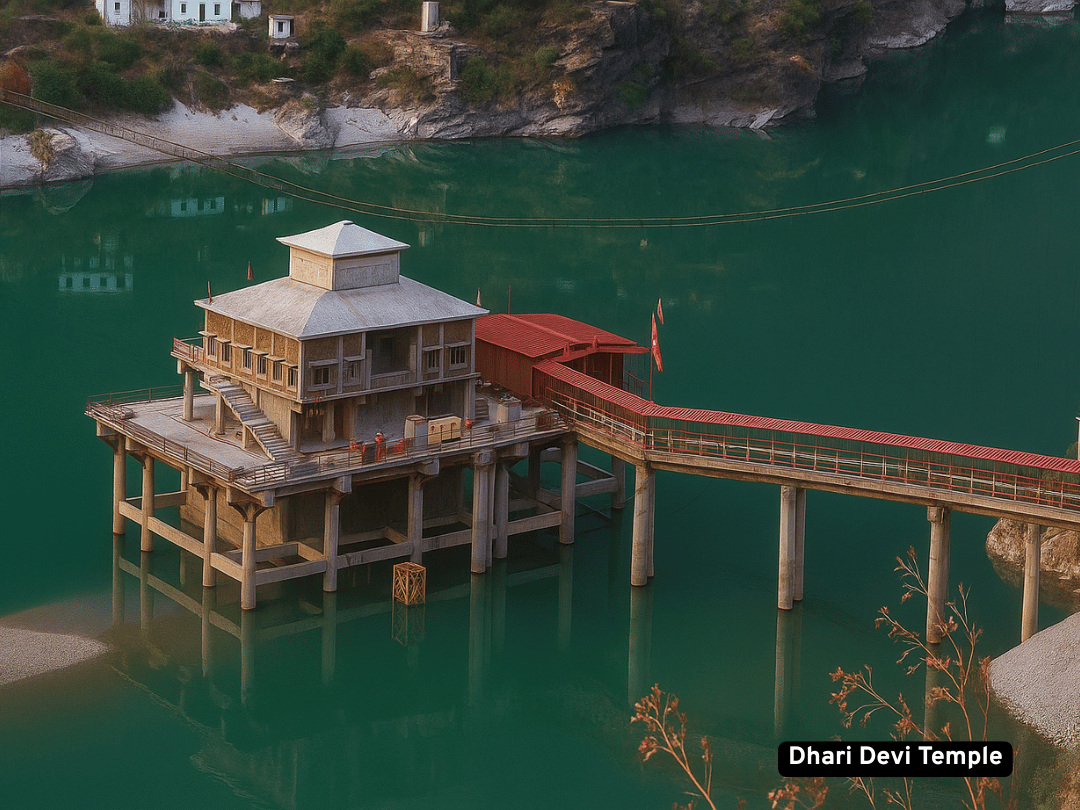
The best time to visit Dhari Devi Temple is from March to June and September to November, when the weather is pleasant and suitable for travel. Avoid the monsoon season (July to August) due to the risk of landslides and flooding in the region.
By Road: Easily accessible via NH-58 from Rishikesh, Haridwar, or Rudraprayag. Taxis and buses are available till the temple entrance. By Rail: The nearest railway station is Rishikesh (about 120 km). By Air: The nearest airport is Jolly Grant Airport, Dehradun (around 130 km away).
{}
650 meters
Dhari Devi Temple is a revered Hindu shrine located on the banks of the Alaknanda River, between Srinagar and Rudraprayag in Uttarakhand. Dedicated to Goddess Dhari, a fierce manifestation of Kali, the temple is considered the guardian deity of the Char Dham region. Perched on a raised platform amidst flowing waters, the temple exudes divine energy and is believed to protect Uttarakhand from natural calamities.
Dhari Devi Temple is one of the most revered shrines in Uttarakhand, located on a raised platform in the middle of the Alaknanda River near Kalyasaur, between Srinagar and Rudraprayag. Dedicated to Goddess Dhari, a fierce manifestation of Kali, the temple is believed to be the protector of the Char Dham pilgrimage route and the guardian deity of Uttarakhand.
Unlike traditional temples, Dhari Devi's idol is worshipped in the open, under the sky, as per local customs. The idol is said to change form throughout the day—appearing as a young girl in the morning, a woman in the afternoon, and an old lady in the evening—symbolizing the three stages of life.
Dhari Devi Temple holds deep historical and mythological significance in Uttarakhand. It is believed that the idol of Goddess Dhari appeared at this very spot after a flood washed it down the river, and the locals enshrined her on a rock in the Alaknanda. The temple has been worshipped for centuries as one of the 108 Shakti Peethas and is considered the protector deity (Raksha Devi) of the Char Dham route. In 2013, the idol was briefly relocated for a hydroelectric project, which many locals believe triggered the catastrophic Kedarnath floods—a sign of divine wrath. Since then, the temple has gained even more spiritual reverence.