
Treks by
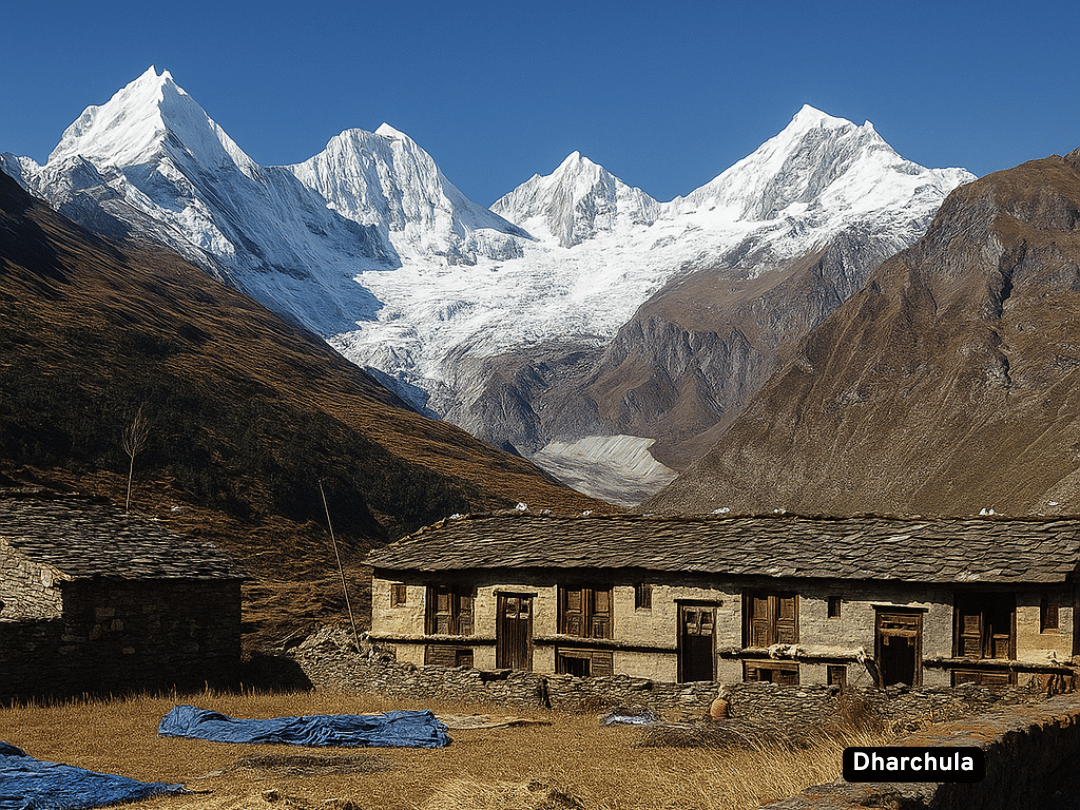
April to June and September to December are the ideal months to visit Dharchula.
By Air: The nearest airport is Pantnagar Airport, approximately 317 km away. Taxis and buses are available from Pantnagar to Dharchula via Almora and Didihat. By Train: The closest railway stations are Tanakpur (218 km) and Kathgodam (265 km). From these stations, you can hire a taxi or board a bus to reach Dharchula. By Road: Dharchula is well connected by road to major towns in Kumaon like Pithoragarh (92 km), Didihat, and Almora. State-run and private buses, as well as shared jeeps, operate regularly from these towns.
{}
940 meters
Dharchula is a serene hill town perched at around 940 m in Uttarakhand’s Pithoragarh district, nestled in a lush Himalayan valley. It splits into two twin settlements—one in India, one in Nepal—on either side of the Kali (Mahakali) River, which forms the international border and allows local cross-border movement without visas.
Dharchula is a scenic hill town nestled in the Pithoragarh district of Uttarakhand, perched along the Kali River which forms the natural border between India and Nepal. This unique town is divided into two parts—one on the Indian side and the other in Nepal—yet both share deep cultural and economic ties, allowing local residents to cross the river freely for trade and social interactions.
Surrounded by majestic Himalayan peaks and dense pine forests, Dharchula offers a tranquil retreat for nature lovers and spiritual seekers alike. It serves as a base for treks to Adi Kailash, Om Parvat, and Narayan Ashram, making it a key stop for pilgrims en route to sacred Himalayan destinations.
Ancient trade hub: Dharchula flourished as a key barter-trade center on the Trans‑Himalayan route, exchanging handicrafts (like carpets/dari) with Tibet until the 1962 Indo‑China War disrupted trade Etymology & spiritual heritage: Its name comes from Rung words — Darchyo (holy flag) + la (honorific) — reflecting its spiritual roots . The area is also linked to sages like Vyasa Muni, who meditated here Dynastic connections: Tied to the Katyuri dynasty’s influence and later the Chand era, the region saw flourishing hill-polities and established cultural festivals like Ghughutiya in neighboring Kumaon