
Treks by
March to June: Pleasant spring and early summer weather, ideal for visiting temples, attending public teachings, and enjoying mountain views September to November: Clear skies, crisp air, and post-monsoon freshness – excellent for spiritual retreats and walks Winter (December to February): Cold but peaceful; lower crowds, with occasional snowfall adding to the temple atmosphere Avoid July–August (Monsoon): Heavy rainfall may cause landslides and reduce visibility
By Air: Nearest airport is Gaggal (Kangra) Airport, around 20 km from McLeod Ganj. Taxis are available at the airport and take about 45 minutes to reach. By Train: Pathankot Railway Station (~90 km) is the nearest broad-gauge station. From Pathankot, you can take a taxi or board a bus to Dharamshala (4–5 hours). By Road: McLeod Ganj is well connected by buses and taxis from Delhi, Chandigarh, and Amritsar. From Dharamshala bus station, it’s a 20-minute ride to McLeod Ganj, followed by a short walk to the temple complex.
{}
1,770 meters
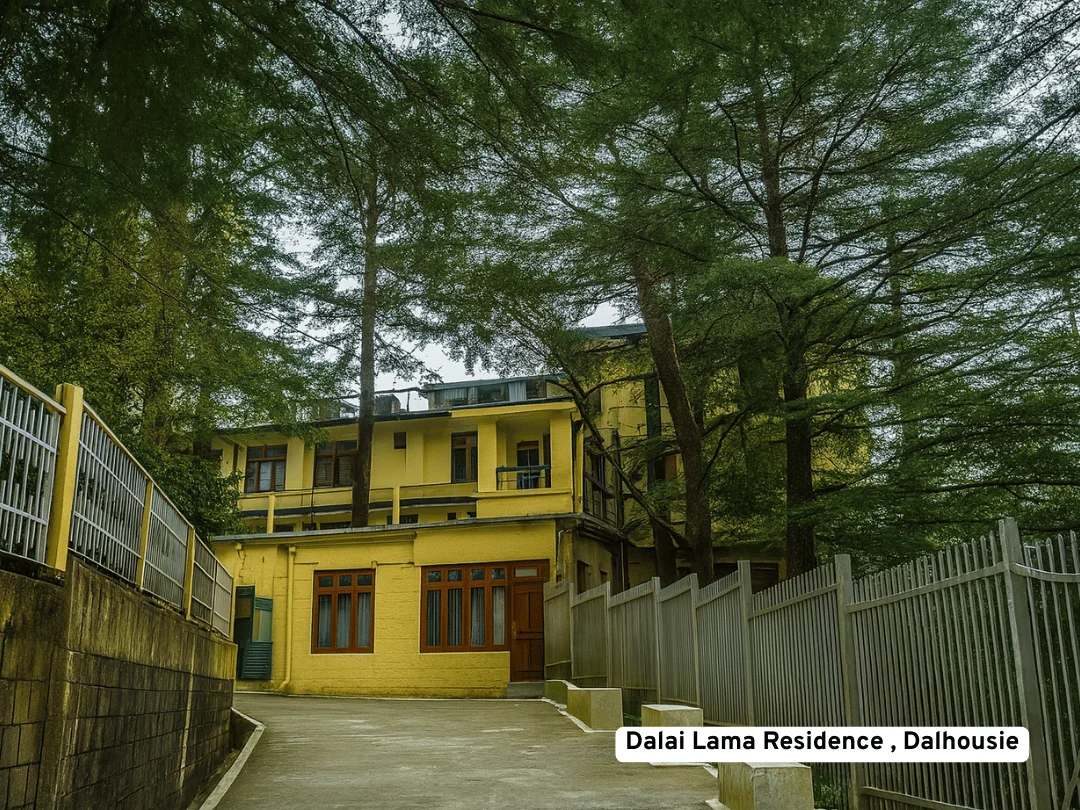
The official residence of His Holiness the 14th Dalai Lama is located within the Tsuglagkhang Complex in McLeod Ganj, Dharamshala, Himachal Pradesh. It has served as his home since 1960, after he fled Tibet and was granted asylum in India. The residence is a private and secure space within the larger temple complex, where the Dalai Lama lives, meditates, and occasionally meets visitors, scholars, and global leaders. While the residence itself is not open to the public, its surroundings—including the prayer halls, Namgyal Monastery, and Tibetan Museum—can be freely visited. Set against the backdrop of the Dhauladhar mountains, the residence reflects a peaceful, humble lifestyle, deeply rooted in Tibetan Buddhist values of compassion, simplicity, and wisdom.
Nestled in the hills of McLeod Ganj, within the Tsuglagkhang Temple Complex, lies the official residence of His Holiness the 14th Dalai Lama. This quiet, secure compound has been his home since 1960, when he arrived in India as a refugee after escaping from Tibet during the Chinese occupation.
While the residence itself is not open to the public, it stands as a powerful symbol of spiritual leadership, non-violent resistance, and cultural preservation for Tibetans and the global community.
The Dalai Lama’s residence is part of a larger sacred space that includes:
Namgyal Monastery, the personal monastery of the Dalai Lama
Tsuglagkhang Temple, the main prayer hall with large Buddha statues
Tibetan Museum, documenting the story of Tibet’s struggle
Public teaching grounds, where thousands gather for his teachings
The residence is a modest, gated structure, surrounded by tall trees, gardens, and a peaceful walking trail. Its architecture reflects Tibetan simplicity, built for contemplation rather than luxury.
From this Himalayan home, the Dalai Lama has led the Tibetan exile movement, advocated for global peace, and hosted dignitaries, scholars, and world leaders. It is from here that he shares his message of compassion, interfaith harmony, and non-violence, inspiring millions worldwide.
Although his teachings are delivered from adjacent halls, the residence remains the private spiritual retreat where he meditates, writes, and guides the monastic and Tibetan community.
While visitors cannot enter the residence itself, they can:
Circumambulate along the prayer wheel path behind the residence
Attend public teachings and prayer ceremonies at the nearby temple hall
Visit the Tibetan Museum and library within the same complex
Observe monks in daily practice and engage in silent reflection
Place: Tsuglagkhang Complex, McLeod Ganj, Dharamshala
Altitude: ~1,770 meters
Nearest Airport: Kangra (Gaggal) – 20 km
Nearest Rail: Pathankot – 90 km
Accessibility: Short walk from McLeod Ganj market
Home of a global spiritual leader and Nobel Peace Prize laureate
Center for peaceful resistance and Tibetan identity in exile
Surrounded by meditation spaces and monastic teachings
A must-visit pilgrimage site for Buddhists and seekers of peace
The Dalai Lama’s residence in McLeod Ganj is a vital landmark in the history of modern Tibetan Buddhism. After the Chinese occupation of Tibet in 1959, His Holiness the 14th Dalai Lama, Tenzin Gyatso, sought refuge in India. In 1960, the Indian government welcomed him to settle in McLeod Ganj, a quiet hill station in Himachal Pradesh. Since then, his residence has become the spiritual and administrative center of the Tibetan government-in-exile, as well as a global symbol of non-violent resistance, peace, and religious freedom. Over the decades, the residence has hosted world leaders, Nobel laureates, spiritual seekers, and thousands of Tibetan refugees, all drawn by the Dalai Lama’s teachings and presence