
Treks by
March to June: Pleasant weather, clear skies, and blooming valley views September to November: Post-monsoon freshness with crisp air and scenic vistas Avoid: July–August (heavy rains, slippery trek) and December–February (snow may block routes)
By Air: Nearest Airport: Bhuntar Airport (Kullu–Manali Airport) – ~25 km From Bhuntar, take a taxi or local transport to Chansari village (base point for trek) By Train: Nearest Railhead: Joginder Nagar Railway Station (~125 km) Further travel required by road to Kullu and then Chansari By Road: Well-connected by buses and taxis from Manali, Shimla, and Delhi to Kullu From Kullu, drive to Chansari village (~12 km), followed by a 3–4 km uphill trek
{}
2,460 meters
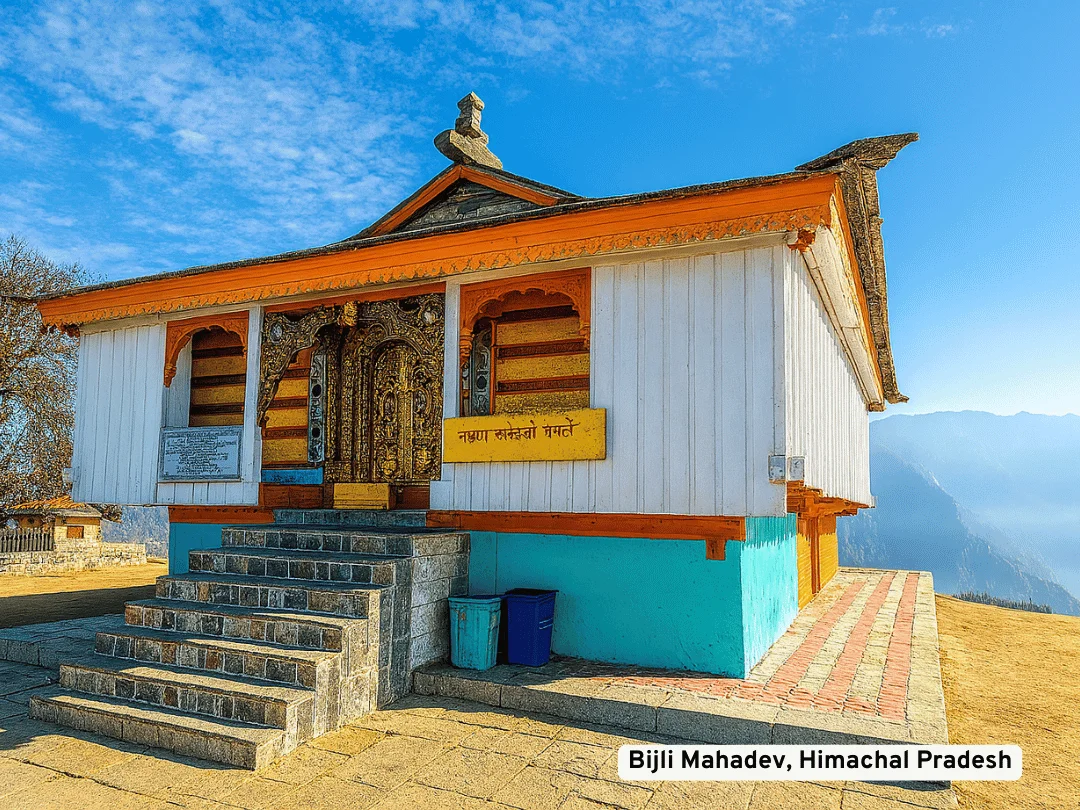
Bijli Mahadev Temple is a revered shrine dedicated to Lord Shiva, located near Kullu in Himachal Pradesh at an altitude of around 2,460 meters. Known for its miraculous legend, the temple gets struck by lightning every few years, which shatters the Shiva Lingam. Local priests then restore it using butter and sattoo—a unique ritual that gives the temple its name, "Bijli" (lightning). Surrounded by deodar forests and offering panoramic views of the Kullu and Parvati valleys, it’s a popular trekking and spiritual destination for devotees and adventure lovers alike.
Bijli Mahadev Temple is one of Himachal Pradesh’s most spiritually significant and visually stunning temples, located atop Mathan Hill near Kullu town at an altitude of approximately 2,460 meters (8,070 feet). Dedicated to Lord Shiva, this ancient temple is famed not only for its religious significance but also for its mysterious connection with lightning—hence the name “Bijli”, meaning lightning in Hindi.
What makes Bijli Mahadev truly unique is the mythical phenomenon that strikes it every few years: a powerful lightning bolt hits the Shiva Lingam inside the temple, shattering it into pieces. Local priests, in a sacred ritual, piece it back together using a paste of butter and sattoo (roasted flour), believed to be divinely guided. This cycle of destruction and restoration is seen as a divine message from Lord Shiva, showcasing his power and protection over the valley.
The temple is built in traditional Kath-Kuni style, using wood and stone, with a sloping roof suited for high-altitude weather. A 60-foot tall flagpole (Trishul) made of deodar wood stands near the temple, believed to attract divine lightning during thunderstorms.
Inside the temple, the Shiva Lingam resides in a peaceful, dimly lit sanctum that exudes spiritual calm, drawing devotees from all over North India.
Reaching the temple requires a moderate trek of 3–4 km from Chansari village, through scenic trails lined with pine, cedar, and deodar trees. At the top, visitors are rewarded with breathtaking 360-degree views of the Kullu Valley, Beas River, and the Parvati mountain range. It’s especially mesmerizing at sunrise and sunset.
Bijli Mahadev is not just a place of worship but a location where mythology meets natural wonder. Devotees, trekkers, and nature lovers visit to experience divine energy, Himalayan serenity, and dramatic weather patterns. The temple is also a vital part of local Kullu traditions and is visited heavily during Shivratri and Saawan festivals.
Bijli Mahadev is an ancient temple with strong roots in Shaivism, dedicated to Lord Shiva—the destroyer and transformer in Hinduism. Though there is no exact historical date for its construction, local lore and legends date it back hundreds of years, passed down through oral traditions. The temple is best known for the mystical lightning phenomenon, where every few years a bolt from the sky strikes the Shiva Lingam and breaks it into pieces. It is then ritually restored using butter and flour (sattoo) by temple priests—a rare and divine occurrence that has earned the temple its name, Bijli (lightning) Mahadev.