
Treks by
May to June and September to October (Avoid July-August due to monsoon; closed in winter due to heavy snowfall)
By Road: Reach Badrinath via NH7 from Haridwar, Rishikesh, or Dehradun (~300–320 km). From Badrinath, Mana village is 3 km away—can be walked or reached via local taxi. Bhim Pul is a short walk of 10–15 minutes from the Mana entrance. By Train: Nearest railway station: Rishikesh Railway Station (~290 km) Then take a taxi or shared cab to Badrinath. By Air: Nearest airport: Jolly Grant Airport, Dehradun (~310 km) Continue by road to Badrinath via Joshimath.
{}
3,200 meters
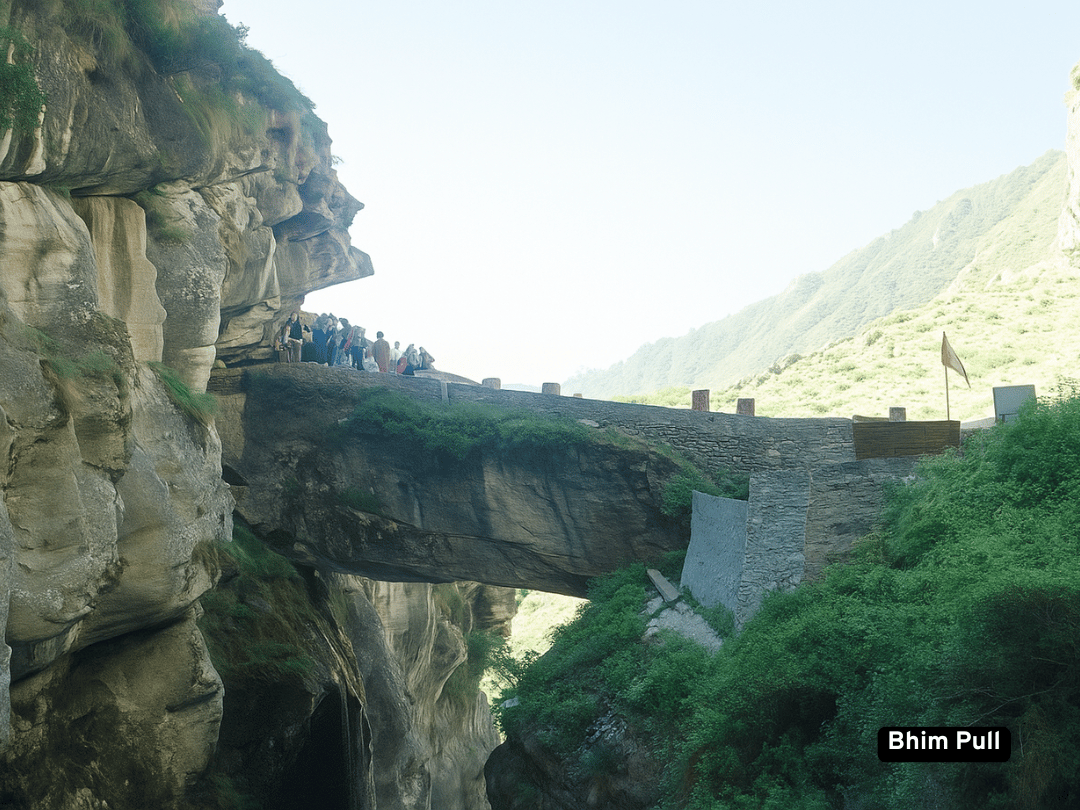
Bhim Pul is a legendary stone bridge located in Mana Village, the last inhabited village on the Indian side near the Indo-Tibetan border, just 3 km from the sacred town of Badrinath in Uttarakhand. This natural rock bridge spans the roaring Saraswati River, which emerges dramatically from a narrow gorge at this point. According to Hindu mythology, Bhima, the strongest of the Pandava brothers, created this bridge by placing a massive rock over the river to help Draupadi cross safely during their final journey toward heaven, known as the Swargarohini Yatra. This mythological tale makes Bhim Pul not just a geographical marvel but also a spiritual site of deep cultural reverence.
Tucked away in the mystical village of Mana, just 3 km from Badrinath Dham, lies Bhim Pul—a legendary natural rock bridge with roots deep in the Mahabharata. This bridge is believed to have been placed by Bhima, one of the five Pandava brothers, over the fierce Saraswati River to help Draupadi cross during their heavenly journey to Swargarohini.
The rock itself is massive, resting naturally across the river with such precision that it resembles a man-made structure. Yet it is entirely natural—enhancing the sense of divine intervention. Right beside the bridge, you’ll witness the emergence of the Saraswati River, thundering out from a narrow gorge and disappearing into the ground a few meters ahead, adding a mystical touch to the site.
Bhim Pul holds immense mythological importance in Hinduism. According to the epic Mahabharata, the Pandavas passed through this region on their final pilgrimage to Swargarohini, the path to heaven. When Draupadi couldn’t cross the fierce Saraswati River, Bhima lifted a huge boulder and placed it across the river, creating a natural stone bridge—now known as Bhim Pul. Nearby caves like Vyas Gufa and Ganesh Gufa are said to be the places where Ved Vyas and Lord Ganesha composed the Mahabharata. The entire area resonates with epic legends, making it a spiritually and historically rich destination.